Showing posts with label Caving. Show all posts

Wednesday, July 22, 2015

STONES UNTURNED--CAVING IN WESTERN VIRGINIA

Fog and vapor hangs thick in the air as we drive westward towards the rugged, veiled peaks of the Blue Ridge that shield the view of the highlands beyond.  Long sleeves and pants wear heavy in the summer heat.  Threatening clouds stall on the horizon, but weather doesn’t matter when your destination is underground.

    David Small, student government and outdoor adventure teacher at Fluvanna County High School; three Fluvanna grads, Travis, Chris, and Small’s daughter, Erin; and I exit a road-seasoned Subaru at the “trailhead” for the day’s adventure around midday.  After a two-hour car ride, we are ready to mobilize.

Photo by Matt Reilly
    Packs are filled with food, water, extra batteries, maps, first aid supplies, and cameras.  Headlamps are double-checked for functionality.  Boots are laced, and some tape their ankles and wrists.  Hardhats and gloves for safety and tact are distributed and donned with firmness—a muted excitement and acknowledgement of the risk involved with venturing underground.

Photo by Matt Reilly
    “The most dangerous part is getting to it!” Someone exclaims. 

    At the foot of the short foot trail marred by mud puddles and root systems towers a rock face.  Only a small opening of about two feet offers advancement.

Photo by Matt Reilly
    Wriggling through the cave entrance, “breakdown”—a collection of chunk rock indicative of the cave’s mouth crumbling—greets us.  It is clearly visible in the twilight zone, making footing easy—mere practice for what’s to come. 
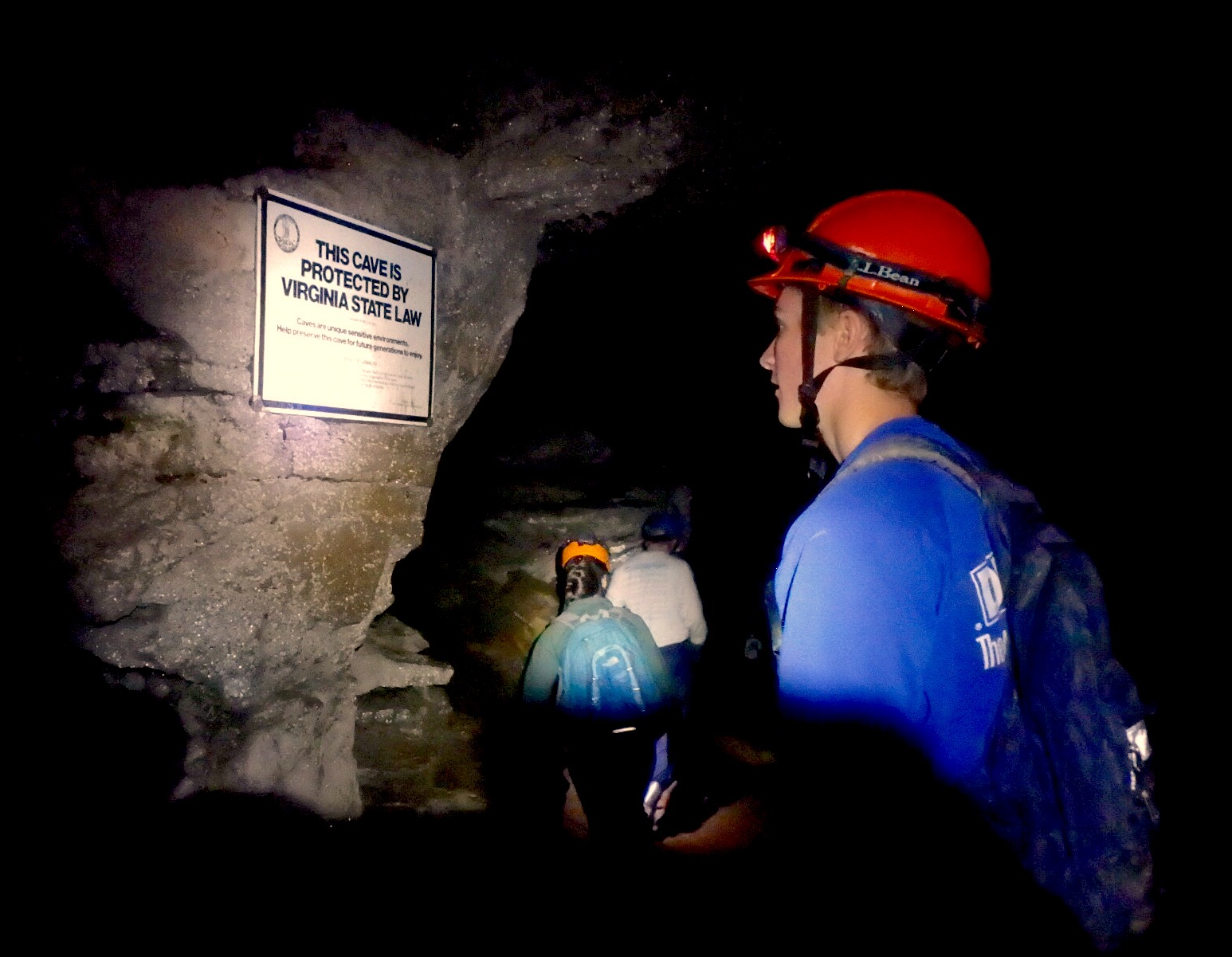
Photo by Matt Reilly
    Deeper we advance.  Daylight fades.  The ceiling drops.

    “Three points of contact,” Small announces encouragingly. 

    The ground becomes slick with mud; the footing, technical. 

Photo by Matt Reilly
    Hand.  Hand.  Foot.  Swing.  A mental checklist becomes subconscious.  Footing is not hard to come by in most circumstances, but lose balance or place a foot too far and you may take a hard fall or break a leg in a hole.

    Small is comfortable with his knowledge of the passages—comfortable enough to navigate pitch dark with just a headlamp and a map.  However, for safety, we leave a bread-crumb trail of yellow marking tape, placed directionally on visible rocks at points of intersection.  There are countless opportunities to get lost here.  Even more in the dark.

Small checks the cave map.  Photo by Matt Reilly
    Such is the allure of caves.  Unlike the first cave I ever explored, the entrance to this cavern is tight.  I have seen holes of equal and larger size in my wanderings in the mountains on multiple occasions.  Only this one is a portal to miles of underground passages, and there are countless more within the cave, presumably unexplored.  There is great potential for virgin, unexplored territory.

    We reach an intersection.  The main passage swerves to the left.  A crag steeps to the left.  A length of mud-crusted para-chord used for navigation extends into the crag, limp.  Where does it lead?
    
    We proceed without discovering the answer.

Freddy the Cave Frog.  Photo by Matt Reilly
    If I had any prior inkling of the bowels of the Earth where we tread, I would be referring to these sights with reference to specific locations, officially dubbed on the map.  But I am a newcomer in this venue.  Each new encounter is a hard, muddy, and slippery obstacle and I love it.  It’s a physical challenge to the other half of the body’s muscles—the ones not used on an everyday basis.

    “The Pit.”  That toponym does stick with me, if only for its blatant expression of struggle.  The main passage extends up, through a tricky tunnel of boulders and sharp rocks.  A pack will catch, and must be thrown or handed up.

    As is the case in many spots, the map indicates two possible routes to the same end.  The one that Erin and I choose is an underground creekbed that travels underneath “The Pit,” but requires a tight initial squeeze that soaks you to the bone with spring water. 

    On the other end, we are met with what now seems like a foreigner—a plump toad positioned at the mouth of the creek.  The troglobite—or cave dweller—was assumed blind for its habitation deep in the dark zone of the cave, and for its lack of hopping reflexes when confronted.


Chris Markham attempts a tight squeeze.  Photo by Matt Reilly.
Checking the Cave Map at Short Man's Shortcut.  Photo by Matt Reilly
    As we pushed on, the passage began to tighten.  Eventually we found ourselves at what seemed to be an impasse—“Short Man’s Shortcut.”  A dead-end offered only a 9-inch tall tunnel for advancement.  None of us fit, and none wanted to push their luck nearly a mile from daylight and under hundreds of tons of earth.  But as we sat there in resignation, headlamps fixed on the cave map, rumors of an underground river accessible through the cave and the tight passage before us fueled our sense of adventure.  There is always more to discover.

*Originally published in the Rural Virginian

Wednesday, February 4, 2015

ADVENTURES UNDERGROUND

And there it was—the feeling that all had not been explored, that there is potential for virgin country in our American backyard.  Modernity lends us this injustice, that six centuries after the age of exploration, we must strive to escape an urbanized globe and find ourselves outside the reaches of roads, noise pollution, and fellow wanderers to achieve a consensual ignorance in which we lead, if only for an afternoon, an exposed, wild existence.  And then it hit me, as a kiss from an overhead stalactite.

    Below the bi-state city of Bristol, a small tributary to the South Holston River gurgles out from a rocky bluff in a hardwood hollow.  Rural countryside greets its escape from the hollow—a landscape that fails to suggest what lies in the trickle’s headwaters.

    That particular headwater I, along with a group of nine, traced into the mountain—or rather under it.  A wall of warm, stagnant air hit our faces as we ducked beneath a low ceiling.  With that, donning hard hats and headlamps, we were inside the best natural spelunking cave east of the Mississippi.  Exploration was not lost.

    As we were warned prior to takeoff, the setting is a living, wet cave, still forming as minerals drip from the cave ceiling and stalactite canals to the floor, creating pillars and mounds and a generally muddy surface composition.

    Old clothing is the uniform of champions here.  Not in the “wear old clothes in case they get dirty” sense, but in the “they will be ripped, punctured, shredded, soaked, and muddied beyond belief” sense.  Old work pants and a cheap sweatshirt or long-sleeve t-shirt are prime choices.  A synthetic base layer is optimal, along with your choice in synthetic socks.  Shoes should provide adequate protection and traction.  Boots and old sneakers are good choices.

    Within seconds we were on all fours.  Mineral formations don’t oblige body types or skeletal structures.  To progress, we were forced to take shapes, to solve the problems faced, physically.

    After much ducking and crawling, we came to a cliff—an underground mountain of sorts.  Our guide promptly climbed the boulders to the peak, where the chamber continued deeper into the ground, tied off a rope to a triangular rock, and tossed down the hand line.  We repeated this process twice, over two rises, those in the rear chocking the feet of those ahead and spotting as they made the ascent gripping the hand line.

    Because of these situations, being guided as a first-time spelunker is strongly-encouraged.  As one might imagine, spending time underground is dangerous--even more so without any prior experience or training.  Thus, the best way to explore a living cave is through a guide service or caving club, or “grottoe,” associated with the National Speleological Society.  They will be informative and skilled, warning against harming the fragile cave ecosystems and helping to prevent the spread of issues such as white nosed bat syndrome.

    At that time, we had reached the upper level of the cave.  Along the way we took our time in exploring tight spots, which did and did not lead to other rooms; most passed through walls or under the floor to reemerge again. 

    When in such a position, where one can literally not move to the left or right, but difficultly forward and backward, it’s surreal to attempt to observe the scene out of context.  To the average earth-dweller, who inhabits a house or apartment, who exists in the sunlight each and every day, and who makes their tightest squeeze when passing through a door jam or cars in a lot, a two-foot tunnel of living rock below a river and fathoms of earth and mountain is a foreign place to wind up.

    Yet, adrenaline seems to limit reflection or fear in such places.  For, with your arms stretched forward over your head, it’s amazing what crevices a human can navigate.

    As we began our descent, we came upon a hole.  Though hidden by a 12-foot mound, it was perhaps five feet in diameter, and extended downward a few hundred feet.  Crawling over the mound, we crab-walked down the chute until the slope grew steeper and sliding became the effective motive of transport.  One steep downhill turn, and we landed knee-deep in an underground river!

    In the dark, wading perception becomes difficult, particularly with others clouding the water.  So we remained in a straight line, sending clues up and down the line.

    After nearly a half mile of river channel had been covered, we found dry (ok, muddy) land again, and promptly climbed into a slot roughly 10 feet wide by two feet tall and 80 feet long.  An 80-foot roll commenced, and when we were finally upright again, a foreign light penetrated the darkness in our dizzied state.


    The sun.

Originally published in the Rural Virginian