Showing posts with label Squirrel Hunting. Show all posts

Wednesday, August 31, 2016

A TACTICAL APPROACH TO THE UPCOMING SQUIRREL SEASON

As one with knowledge only of a life spent outdoors, I arrange my memories by seasons. By morning dew and the reflection of warm genesis on fresh leaves, I remember days casting dry flies to feisty brook trout and wild rainbows. By thick, starlit nights and the chug-chugging of a popper I recall extended summer evenings fishing for heavy bigmouths from a canoe. By the first chilly, gray morning in September, and the sight of yellow leaves adhered by mist to the rocks of a Blue Ridge Mountain hollow, I remember those days spent toting a .22 long rifle, ears perked to the sound of bushytail toes on bark. That morning is fast approaching.

Photo by Matt Reilly
    This Saturday, September 3, Virginian small game enthusiasts will be given the annual go-ahead to target their favorite quarry—gray squirrels, and the less prominent red and fox squirrels.

    The season on red squirrels and the widely distributed gray squirrels will run through February 28, statewide.

    Fox squirrels are legal game only through January 31, and can only be taken in the counties west of the Blue Ridge, and in the counties of Albemarle, Bedford, Culpeper, Fauquier, Franklin, Greene, Loudoun, Madison, Orange, Patrick, Prince William, and Rappahannock.
The traditional bag limit of a combined six bushytails remains in place.

Three Different Seasons


    Dedicated squirrel hunters enjoy pursuing game with a wide range of implements. Muzzleloaders, riflemen, shotgunners, archers, and airgunners all set their sights on bushytails, both from carefully scouted stands and conveniently located saplings during a still hunt. The right method for you is largely up to preference and ability. However, the Virginia squirrel season is a long one, and so it is worth noting the limitations and strengths of different tactics during the three distinct seasons the squirrel hunter will face between September and February.

    The month of September and early October I call the “early season”. Leaves and acorns still cling to the forest canopy, and squirrels haven’t yet been shot at. Often, this makes finding squirrels easy. They are loud, shaking large bunches of foliage while mining acorns from the treetops, and the foliage somewhat robs them of their bird’s eye view of the forest floor.

    I rarely hunt squirrels in September. In Virginia, the weather is generally still quite warm. However, when I do, I rarely stand-hunt. The squirrels are occupied and relatively stationary high in the treetops. Thus, my favorite way to hunt is to simply wander the woods with an eye on the sky, looking for roiling bunches of foliage. Once a squirrel is located, an easy stalk is usually all that separates one from a shot.

    The length of that shot varies by the cover you hunt, but keep in mind that it can be difficult due to foliage to get a clear shot with a small bore .22 rifle or an airgun. A 20 gauge with a modified choke can be an excellent choice for sorting through all those limbs and leaves, and is often my first choice in the early season.

    I call the “mid-season” that period starting in the latter days of October, and lasting until most of the fallen mast has been used up and there is snow on the ground—usually sometime in mid- to late-December. During this season, the squirrels have been educated a little, but they spend a significant portion of their day on the ground, scrounging for acorns. The forest canopy has thinned, and a longer, more precise shot it possible.

    During this period, stand hunting can be quite effective. Locate areas where there is a concentration of fallen mast, like a hardwood creekbottom or flat oak grove. White oaks tend to drop acorns earlier than red oaks, so know your local hardwood species, and pay attention to their mast-producing tendencies.

    A longer line of sight makes a .22 or air gun very valuable, and will provide more shots from a stand. The subtle crack of the rifle is also less alerting, compared to the invasive boom of a shotgun, enabling a shorter recovery to seclusion.

    The doldrums of winter I consider to be the “late season.” Food is scarce and the woods are bare. Squirrels are spooky and ranging wide. Leaves are crunchy due to cold. What’s more, groups of squirrels are often spotted chasing each other as a mating ritual.

Photo by Matt Reilly
    These reasons make me partial to a very slow still-hunt with a shotgun. Educated squirrels often stick tight to cover when approached, and make mad dashes for cover, making moving shots common. You may be lucky enough to have several squirrels chase each other to within range, in which case, multiple quick shots can pay dividends.


    Keep these variables in mind when planning your days afield this fall and winter chasing Virginia’s favorite small game species.

*Originally published in the Rural Virginian

Tuesday, February 23, 2016

FEBRUARY IS A HARD MONTH TO LOVE

February is a hard month to love. The most ardent endure her harsh temperament--her changing moods--with some success, rarely without sacrificing self, in the form of numb fingers or wind-chapped cheeks.

Photo by Matt Reilly
    February is a time of change, one without which the climactic arrival of spring would be of muted contrast. Snowmelt, under the typically warmer-than-winter closing days of the month, floods rivers and streams with cold, dirty water, while small game seasons peter out. But if February offers any consolation, it’s that taking it by the horns and experiencing the true end of the outdoor year makes spring all the more grandiose.

High, Cold, and Dirty


    Six inches of snow fell over the weekend, and promptly melted, unleashing inches of 36-degree, muddy water on the landscape. If there’s a type of water that warrants hanging your hat up for, it’s this—but when the going gets tough, I find it unacceptable to accept defeat.

    When I arrived at the roadside pull-off, I could hardly recognize the creek that brushes the road. Under normal circumstances, a well-defined run-pool complex passes tranquilly under the shadow of a hemlock-lined bank. With the right angle of sunlight to facilitate, a half dozen or so dark, elongated forms can be seen waving in place like submerged grass in the lucid blue belly of water, fins grazing cobble below.

    This time, however, the scene looked and sounded of chaos. Green-brown water capped with foam rolled and chopped like ocean waves, ignoring the serpentine borders of the creek, and challenging the quiet forest highway adjacent to a contest in violent white noise it was sure to win.

    I learned a lesson in high-water trout fishing in western Maryland three years prior. That river was running roughly four times its typical flow. Wild brown trout filled the river, and I had considerable success fishing soft water behind big boulders along the flooded bank with a large, dark fly. That was mid-June.

    A third odd was stacked against me on that February day—cold water. I knew I’d have to fish slowly, and very thoroughly.

    When a creek jumps its banks, holding and feeding lies are tossed in the air. The food chain scrambles to reestablish footing in the changing system. Small fish are tossed around, and large, predatory fish cruise harsh current breaks, looking for a feeding opportunity.

    A few hundred yards upstream, I found the setting for the scene I prophesized in my mind. A long, hard run ran over chunk rock, tossing water in crests and pits. An abutting slab of bedrock calmed the churning, and pooled a few feet of calm water.

Photo by Matt Reilly
    Several casts with a heavy crayfish-imitating fly into the seam ended with a hard stop and the turn of a massive female brown trout that ran downstream, broke me off, and became my latest heartbreak.

Two Triples


    A crisp, sunny afternoon in February beckoned me to the squirrel woods, amped with adrenaline, 20-guage pump shotgun in tote.

    Late season bushytail hunting, in my mind, speaks of delicate walking, skittish squirrels, and quick shots—a game tailored to the indiscriminate, somewhat forgiving reach of a boom-stick.

    Just barely inside the treeline, as I stood mid-way up a hardwood ridge, sun to my back, three squirrels busted from cover, nervous from my prolonged pause, and darted for independent cover. Swinging, and operating the pump-loading mechanism instinctively, I dropped all three on consecutive shots—a triple, for half a limit.

Photo by Matt Reilly.
    Another 45 minutes of still hunting landed me in position to take another bushytail. From a creekbottom, I closed the distance between me and the rustling I could hear near the top of the ridge, hopping and skipping in bursts, imitating the sound of a pouncing gray squirrel.

    The first shot was presented when an alarmed gray pounced from the trunk of an oak tree into the branches of another. As it was scrambling to establish footing, I dropped it with a swinging report from the 20-guage.

Photo by Matt Reilly.
    A second bushytail peeked out from behind the trunk of a neighboring oak, curious, presenting a headshot that didn’t go unclaimed. Down went another batch of meat for the pot.

    A third held tight to the forest floor for 30 seconds before making a mad dash for a nearby hickory tree. I ran forward ten feet as the squirrel began its ascent of the trunk, and interrupted it, taking a quick knee, and firing a rising snap-shot—a second double, for a limit of late season bushytails.


 *Originally published in the Rural Virginian

Thursday, February 12, 2015

SQUIRRELS AND RABBITS STILL LEGAL

In early February, the out-of-doors can be an inhospitable place, and with deer season long concluded, many outdoorsmen hang their hat and dream about spring by the fire.  However, thanks to last year’s regulation amendment, squirrels remain in-season with rabbits, until the last weekend in February.  Pursuing either may provide enough adrenaline to ward off winter’s chilly advances.

Photo by Matt Reilly


Two Triples

    
    After a 25-fish morning on a Blue Ridge brook trout stream with my older brother, Phillip, I embarked on my drive home with the sun in my eyes.  The warm mid-day sun had raised the mercury almost 20 degrees since dawn, and I knew the woolly bushytails in my favorite woodlot would be drawn up into the hardwood canopies to soak up the rays.  My trigger finger itched, and I pressed a little harder on the gas pedal.

    Dead oak leaves crunched under my boots with just a few hours of daylight left.  I couldn’t blow any shots and expect to leave the woods with my limit of plump squirrels.  Luckily, I thought, with the winter mating season in full swing, my quarry would be a bit distracted.  Sneaking to within range of a playful bunch might present multiple shots for my 20-gauge scattergun.

    I crossed a small creek at the base of a ridge and paused, listening for activity.  Nothing.  Continuing up the ridge on heel and toe, I made two steps before a gray missile bolted from the trunk of a white oak and began scaling another.  I shouldered my shotgun and landed the bead on the hesitating, spread-eagle gray.  A squeeze of the trigger cashed #6 shot for the evening’s first bushytail.

    I hadn’t shucked the spent shell before two more squirrels fled from the creekbottom.  One made an acrobatic attempt to find safety in an adjacent tree, and a report from the 20-gauge dropped it as it struggled for footing.  The other made an athletic departure along a fallen oak tree, but the third and last shell in my chamber stopped it short. 

    A half hour later I found myself running out of light.  At the base of the next ridge, I could hear the scampering of multiple squirrels in the dense creekbottom, hidden only by a small rise.  When I was sure they were distracted with each other, I closed the distance to a wide oak trunk over the rise in quick bursts, imitating the sound of a pouncing bushytail.

    The first shot was presented when an alarmed gray jumped from the trunk of an oak into the branches of another.  Peeking around my temporary cover, I took aim and sent it tumbling.  The next peeked around the base of another oak, presenting a head shot that didn't go unclaimed.  A third held tight on the forest floor for several seconds before making a mad dash up the nearest hickory tree.  I ran forward ten feet before he began his assent up the trunk and, taking a quick knee, fired a rising shot for a second triple and the last of my limit.

Rabbits in the Open

    
    It was in the final week of the 2012-13 deer season that I was perched high in a tripod overlooking a food plot of clover, radishes, and alfalfa.  The green lanes were cut from the surrounding pine and rose thicket, which I knew to hold scores of cottontails.  In fact, it was rare that I made the walk to my stand without jumping a rabbit or two, and any time spent in the camouflaged perch was likely to see regular bunny traffic coming to the wood’s edge to feed on leafy greens.
    
    A .22 in the place of my .243 would have filled the pot, but instead, at a later date, I approached the thicket with a shotgun and small game loads.  Countless rabbit trails emerge where the pine-needled edge meets grass, so I surveyed for concentrations of traffic before diving into the tangle.

    Once inside, potential rabbit hide-outs are easy to spot.  Bent over cedar trees, hollow logs, rose bushes, tree piles—each should be approached, gun at the ready.  I proceeded in this manner for two hours, and jumped a total of five cottontails.  In each case, it escaped without injury with no shots fired.

    It is typical of spooked rabbits to return to their individual piece of cover when danger has moved on.  However, keeping a tight eye on return routes, I could detect no movement after several minutes of waiting. 

    Regardless, there is no better way to jump-start your heart in the frozen February woods than with the spirited exodus of a fleeing rabbit.  With any luck, next time’s score will lean in my favor!

Originally published in the Rural Virginian 

Sunday, December 21, 2014

CASTIN" & BLASTIN": THE BLUE RIDGE MIX

Today was a successful day, to say the least.  

    I met Phillip at his house in Charlottesville and drove to a small brook trout stream in the Blue Ridge, arriving around 8 AM.  After a short hike, we collectively took 40 brook trout over the course of two hours--all, for the most part, on the wonderful little nymph I will show you all how to tie in the near future.  Be on the lookout.


Photo by Matt Reilly
    After returning home and hitting the local pharmacy for some discount fly tying materials, I hit the woods with my 20 gauge pump shotgun for the last hour and a half of light.  Fishing manager of Orvis Charlottesville, Jeff Greendyk, and I, have been devising a plan to learn how to dye fly tying materials--squirrel tail in particular--and I needed materials.  

    In the first ten minutes in the woods, I busted three squirrels holding tight on the forest floor.  They scattered, and I dropped each on three consecutive moving shots.  A triple, on squirrels, for half a limit of the gray bushytails.  


Photo by Matt Reilly
    Another 45 minutes of stalking put me in position to take another squirrel.  From the base of a ridge, I closed the distance to the scurrying and pouncing on the ridge crest quickly, by hopping and skipping in bursts, imitating the noise made by a moving squirrel.  The first shot was presented when an alarmed gray pounced from the trunk of an oak into the branches of another.  And as he was scrambling to establish footing, I dropped him with a swinging report from the 20 gauge.  The next peeked around the base of another oak tree, presenting a head shot that didn't go unclaimed.  Down went another batch of materials and food.  The third held tight on the forest floor for about 30 seconds before making a mad dash up the nearest hickory tree.  I ran forward ten feet before he began his assent up the trunk, which I interrupted, taking a quick knee and firing a quick rising shot.


Photo by Matt Reilly

Photo by Matt Reilly
    With a half hour of light left, I got all the squirrels cleaned and quartered, and landed the tails and one skin in the freezer covered in salt for preservation for dyeing at a later date.  

    To round off the productivity, I was offered two work opportunities--one regarding Adventures Afield, as a column, and another in production fly tying.  More to come on those opportunities!

Tuesday, October 21, 2014

A MONDAY CAST N' BLAST

There's something magical about rising before the sun, making preparations to leave, and heading for the woods or the water.  Maybe it's knowing that the scene that unfolds before dawn is the prologue to great outdoor experiences everywhere, that it's a tradition as old as the sport.  Whatever the reason, I was starting the week off right.

    I made the hour and a half drive south to a delayed harvest creek I just discovered a few days ago and wanted to explore.  The land surrounding the fishery is said to be rolling hardwood forest.  So without the slightest bit of hesitation in thought, I aimed to include a squirrel hunt to my trip.  My Tycoon Tackle Scion fly rod and Marlin .22 rode in the back.

    There was still a heavy frost on the ground when I parked the Versa on the grassy shoulder just up the hill from the bridge spanning the creek I was to fish.  The sun was barely breaking the crowns of the bare poplar trees in the creekbottom, and I watched my breath float away into the autumn woods as I got into waders and rigged up my rod.


Photo by Matt Reilly
Photo by Matt Reilly 
Photo by Matt Reilly
    I try to keep fishing for stocked rainbow trout simple.  Woolley Buggers and Golden Retrievers will do damage just about anywhere; and these fish aren't picky.  So with a golden tied to the end of my tippet, I slipped into the woods, crunching on sycamore leaves all the while.

    The large bridge pool was dark and deep.  The occasional rise broke the glass-like surface and sent a delicate air bubble into the atmosphere.  Not wishing to spook any fish, I cautiously edged down the bank into the tail of the pool, check my backcast, and laid out a long cast down the pool's center.


Photo by Matt Reilly
    I let the fly settle, then began a strip retrieve.  Bam!  The line hesitated in the film on the water's surface, and I swept the long rod to the side as it bent under the weight of a fiesty trout.


Photo by Matt Reilly
    The sequence of events repeated itself twice thereafter before I decided to venture further downstream.  If there were fish here, surely some would have ventured downstream.  So I jumped on the trail and took a hike--an hour-long hike--downstream, with the intent of fishing my way back up to the bridge.

    I came to another bridge over the creek some two miles downstream; and by then it was 10:00 AM, and the sun was warming the woods.  The squirrels were awakening.

    Turning, I began fishing upstream, but to no avail.  Even the likely-looking holding spots, when dissected by 15 or 20 casts yielded no results.  A fine bushytail observed my dedicated casting shortly after it begun, and I later wondered why I had postponed my hunt until the afternoon, when none of the downstream water held fish.


Photo by Matt Reilly
    In truth, I should have hunted the morning hours before the sun hit its peak in the sky, then fished through midday, and resumed hunting in the evening; for it is my belief that stocked rainbows don't go on the feed at first light anyway, but squirrels are active in the morning, and lay up to sun themselves come noon.  Oh well, that's what exploring is about, I suppose.

    When I finally made it back to the bridge pool, I had no more than the three trout caught there at the morning's beginning to my name, so I was excited to give it a go once more.

    With the combined effort of my Golden Retriever and a purple, red, and black Woolley Bugger, I landed 42 fish between 8 and 16 inches in an hour in the shadow of the bridge.  It seemed that the fish had taken up residence in the pool and could not find a reason to venture downstream even to the next pool.  I will keep this in mind when fishing delayed harvest streams in the future.


Photo by Matt Reilly
    Fish #42 was a chunky fish of 16 inches, and rather than continue, I opted to end my bullying at seven times the legal limit of trout caught, for I was bored with the ease and repetitiveness of the fishing.

    Lunch was a peanut butter and jelly sandwich enjoyed in the hatchback of the Versa; and I sipped on a water bottle as I drove down the dirt road in search of a promising stand of mature hardwoods--the venue for my evening's squirrel hunt.

    The afternoon brought with it a steady breeze, which I knew would make squirrel sighting difficult.  The first grove I chose offered no squirrel sightings, though there were plenty of large oaks, hickories, and poplars present.  For just an hour and a half south of  my Fluvanna County home, I noticed, the woods were noticeably greener and fuller than those at home, adding to the challenge.


    With two hours of light left I opted to get back in the car and head back to the bottom of the second bridge over the creek, where I had seen a substantial amount of mast crop, and the single squirrel that found my fly casting so intriguing.  But after surmounting hardwood ridges bordering both sides of a mile-long stretch of creek, I had yet to see a squirrel.

    On such a long day, if dusk threatens and I haven't yet dropped a squirrel, I often don't aim to.  Taking the time to clean one animal so late in the hunt is exhausting and unnecessary for me to feel accomplished.  So, as is my practice, I located a beech tree, picked a small white spot on its bark, and unloaded my .22 in its center.  At least I know I could've hit a squirrel given the chance!

     I had hoped to mirror my successful morning with the trout with a limit of squirrels in the afternoon, but maybe that's just selfish.  Pleased with the day, I shed my field vest and rifle into the back of the Versa, and rode home through the chilling night with the windows down.

Sunday, October 19, 2014

SQUIRRELS ON THE MIND

Perhaps it's the wonderful memories I made in the woods in my early childhood years with my father or the first solo adventures I had in our subdivided woodlot with my very own Daisy pellet gun.  Or maybe it's the influence of the late Bob Gooch following me in the field as I weave stories of my own; but nothing welcomes in the fall season for me like a calm, cool day in the squirrel woods.

Photo by Matt Reilly
    The squirrel season in Virginia opens on the first Saturday in September, but personally, I acknowledge its beginning when the crisp air and smell of turning leaves floats lightly through the poplar groves on a slight autumn breeze, and the trees are yellow and growing bare.  There's just something mystical about this time of year in the Blue Ridge and the surrounding foothills; and squirrel hunting provides a stress-free, exciting, and active means by which to enjoy it.  Scouting helps, but is not required for success, and it's rare to go more than an hour without seeing a bushy, gray form bouncing along the forest floor or performing acrobatics in the crowns above.  One can simply relax.

    My first squirrel of the season has already fallen, but I look to enjoy my first hunt in the near future.  Maybe somewhere new, where I can explore.  Look for the story in days to come.

Wednesday, January 15, 2014

IT'S STILL SQUIRREL SEASON

The woods seem dead, dark and growing colder, with a slight breeze filtering through the woodlot over frost-covered oak leaves.  In minutes, the morning sun breaks the horizon, casting warm shadows as it graces towering hardwoods.  The woods come alive, freed from the nocturnal wind and chill.
A Bushytail suns on a branch before beginning the morning's activities.  Photo by Matthew Reilly
        Deer begin to move, without worry—the deer season in Virginia has been closed for two weeks.  One trots to within view, shaking off the wintry night in the woods with every sprightly step.

        When the sun emerges from the rolling ridges in its entirety, another woodland creature is awakened by the warming of the tree trunks.  A gray squirrel scrambles out of his den in an ancient oak and suns for a spell on a branch soaked in sunlight.  Before long, the bushytail abandons his perch, and scuttles to the ground to feed.

        But his descent is intercepted by the tapering bark of a .22 rifle.  He tumbles from the tree and lands with a thump on the forest floor.  I left my bed earlier than even the whitetail to begin my vigil, tucked in a grove of oaks and hickories, and now recoil back, behind cover, memorizing the location of my first squirrel of the morning.

        Deer season may be over, but squirrel season is in full swing.

A New Season


        Historically, the rabbit season has outlasted the squirrel season just as the squirrel season does deer season.  But this year, biologists have discovered reason to extend the season on red and gray squirrels to match the rabbit season’s close on February 28, while the close of the season on fox squirrels remains January 31.  This allots small game hunters three months (September, January, and February) to chase their bushy-tailed quarry without being considerate of the meticulous activities of those hunting bigger game.

        The reason for this change, as stated by Marc Puckett, State Small Game Biologist, is “more [hunting] opportunity without negative impact.”  All of Virginia’s border states set squirrel seasons ending in late February.  Virginia is a regional holdout.

A Different Game


        Early in the squirrel season, food supplies are abundant, allowing squirrels to be easily patterned by the location and presence of hardwood trees.  Foliage still clings to tree branches, shielding the still-hunting hunter from the vision of game feeding in the treetops.
 
        In the late season, hunting is not quite so easy.  Most of the mast has fallen from the trees, as have the leaves, making stalking, and sometimes locating, squirrels a difficult game.

The author with a stocky Bushytail.
Photo by Matthew Reilly
        Squirrels feed primarily on the ground during this time, rooting up acorns squirreled away in the ground in the fall, and eating up the last of those gone unclaimed.  For this reason, I’ve found creekbottoms to be particularly profitable places to hunt in the winter.  Gravity naturally concentrates acorns in hilly country in creekbottoms, where squirrels produce much racket perusing the forest floor for them.  The soft earth and often-wet leaves that are characteristic of creekbottoms permit me to stalk a noisy squirrel while minimizing my own noise.

        I have also observed squirrels feeding on ferns in the winter, which grow predominantly in damp soil, making creekbottoms a prime late season squirrel magnet.

        However, even if you know where to search, squirrels can be reclusive in harsh weather.  Schedule hunts for warm or seasonal days without precipitation or wind.  On days forecast as windy, hunting the morning may allow you a few hours of calm woods.

        If you must hunt windy or exceptionally cold days, hunt protected areas.  In such cases, squirrels will readily assume perches amid the lush, evergreen canopy of pine stands.  Pines are excellent protection from the elements.  Especially when insulated with snow, the thick crowns of white pines retain more heat than skeletal hardwoods, and also serve as a wind block, allowing squirrels to feel more secure at a time when they would have to sacrifice their sense of hearing elsewhere.

        Still, the hunter’s best chance at bagging squirrels may exist in the morning as squirrels rise from their dens.  Scout your woodlot for hardwoods with holes—dens—in the trunks, or bunched, leaf nests in the forks.  Take a stand in an area dense with such trees at daybreak and wait for squirrels to awaken.  Because morning temperatures often recede into the teens and 20s this time of year, squirrels will emerge later in the morning, after the sun has warmed the woods significantly; so being in place well before light is unnecessary.  Squirrels often peer out of their den holes for threats before emerging, so wear camouflaged clothing, and remain still and observant.  If you kill a squirrel, retain your cover, mark its location, and wait for another opportunity.


Originally published in the Rural Virginian                                                         

Wednesday, September 4, 2013

CHANGING SEASONS

Squirrel Season, Bigger and Better


    With the arrival of the first Saturday in September, Virginia’s fall squirrel season will be set into motion statewide.

Photo by Matt Reilly.
    The estimated 33,000 squirrel hunters native to Virginia enjoy the state’s longest small-game season—discounting the clamorous old crow—as they are permitted to pursue their sport a full month after deer hunters abandon their stands.

    However, this year our state biologists have extended the season’s duration.  The 2013-14 squirrel season will run from September 7-February 28.  Virginia is then added to the ranks of states whose squirrel season extends fully into the month of February, including our neighbors North Carolina and Maryland.  Marc Puckett, state small-game biologists assures that low hunting pressure in the late-season does not negatively impact squirrel numbers, and that the extension is a way of increasing hunting opportunities for those devoted sportsmen who chase the bushytail well into the winter months.

    With this change, it’s important that hunters remain informed by reading up with a critical eye on the game laws.  Gray and red squirrels may be hunted the full length of the season in 2013-14.  Their hefty cousins the fox squirrels, however, remain protected by the January 31 closure.  The bag limit remains set at a total of six combined squirrels.

Be Selective or Stay Home?


    The early squirrel season—that is, in my mind, the month of September—is hardly characterized by appropriate hunting conditions. 

    Squirrels are very vulnerable at this time.  Their hurried thrashing through dense summer foliage is an easy giveaway, and hides the hunter’s movements and noise, making close shots possible at times, even if shooting may be tricky.

    I do, however, on occasion tote my .22 into the prime squirrel woods of Fluvanna County in September.  Creeping to within shooting range of a bouncing ball of leaves is an exhilarating experience, but sometimes effortless.  This time of year, squirrels are hardly as gun shy as they become by the climax of deer season, and will many times be just a little too trusting of the human creeping through the understory.

    Too often I find myself exiting the woods with juveniles—the lanky, large-eyed, un-educated members of the squirrel population that don’t carry enough meat to make their skinning and cleaning a worthwhile endeavor.  Even trying to select the largest of the squirrels from the treetops, the leaves that still cling to the trees make distinguishing size difficult.

    These youngsters are truly young-of-the-year, from the year’s second litter.  After being born in late June or July, the juveniles rely on the mother for up to ten weeks before striking out on their own to begin gathering and caching food for winter.  This weaning stage often runs into September.

    For these reasons, I prefer to spend the last month of summer fishing for the numerous species of fish that the Old Dominion hosts.  Biologists from North Carolina may share the same opinion as I, setting opening day of squirrel season at October 14.

Feeding Deer


    Also effective in September, the annual prohibition on deer feeding begins September 1 and runs through the first Saturday in January, or the closing day of deer season.  But this too is subject to change.

    New this year, it is illegal to feed both deer and elk in Buchanan, Wise, and Dickenson Counties at any time.

    The deer feeding restriction has also been extended to endure the length of any deer or elk hunting season in the state.  This covers late urban archery seasons that take place in portions of the state that host overabundant deer populations.

    Feed must now be removed from any baiting site prior to September 1; and a new regulation has been created defining an area as “baited” for 10 days following the removal of feed.

    These laws are aimed at preserving the health of both the public and wildlife.  Most notably, Chronic Wasting Disease (CWD) can be spread in areas where heaving feeding activity concentrates deer unnaturally.  Therefore, it’s illegal to feed deer in Clarke, Frederick, Shenandoah, and Warren Counties, as well as the City of Winchester, where CWD has been confirmed and contained.


    Deer also suffer a loss of “wildness” from human feeding, as they begin to associate humans with their food source and become dangerously trusting.  If you don’t recognize this as a negative issue, inquire from the local Park stations accounts of visitors being badly or fatally wounded by the hooves or antlers of an angry deer—they have many. 

Originally published in the Rural Virginian

Thursday, November 22, 2012

PEOPLE DON'T MAKE GUNS, GUNS MAKE PEOPLE

    As November middles out, outdoor publications greet the impending firearms seasons with reports of the latest and greatest hunting implements, putting forth descriptions spiked with jargon that almost overshadows the reason why we take to the woods carrying these prizes. While hairpin trigger pulls, tight bolt cycles, and krypton gas-charged scopes characterize many hunters’ favorite guns, chances are they learned to hunt and shoot with firearms of a much more modest make. Perched alone in a tripod stand on the Muzzleloader opener, I sat thinking about my first guns, and how they shaped me as a hunter.

    I was fortunate enough to have a father that packed me along with him in the fall woods. Our destination was often a mountainous, hardwood ridge littered with Bushytails, or occasionally a wintry cornfield where our young setter would point out the avian inhabitants with ancestral proficiency. For these pursuits, I was entrusted with a smooth-shooting double barreled shotgun whose caliber I never thought to question. It was a true shotgun in that it had to be handled safely and fired safely, always with the safety sliding back into place following the charge, and it certainly did no injustice to the term “boom-stick.” However, it was lacking in what it propelled. A cap gun of sorts, the birds and squirrels that I did lead—maybe—fell to the administering swing of my father. Regardless, I never once shot a dog or a person, and the rush of the flush wasn't lost on me.

    
    Soon I acquired what Ralphie Parker reverently called “the greatest Christmas gift.” Then, we lived closer to the mountains than we had previously, and I was self-conscious enough to tote my Red Rider BB gun with some newly-granted freedom and explore the mixed-hardwood jungle along the dirt road on which we lived. A short, muddy maintenance road we dubbed the “pump-house road” for the jaded well house that marked the trail’s head was the primary venue for hunting safaris and target shooting. I remember being ordered not to come back without dinner, to which I made the sporting decision that I would take an opossum provided I was eluded by a squirrel—not knowing, of course, of their table-fare. Even so, at most, the BB gun killed a few unfortunate pine bark cells, but never before I had exhausted my efforts until nightfall, and always without endangering anything besides blue jays and gray squirrels.

    We moved again, this time to an undeveloped neighborhood in the Piedmont. It was then that my parents entrusted me with an air rifle. Unlike the Red Rider, my new Crosman was scoped—implying true lethality—and could handle pellets or BBs—an obvious contradiction to Ralphie’s declaration. The pneumatic’s 600 fps could hardly drop a mighty Bushytail. Nonetheless, I was trusted to pursue my hunting endeavors alone, venturing across numerous unclaimed lots, often coming home after dark after losing my silhouetted quarry among the darkening trunks. The Crosman’s chamber was opened by a hard-edged lever, and I can remember a determination, after missing almost a hundred shots, that drove me to rub raw my numb, cracking hands in hopes of finally reaching out to a squirrel scurrying along the branches.

    It wasn't until my tenth year that I was granted an arm of true firepower. The upland preserve season was growing cold and bare in Virginia and my father felt it fitting that I carry my own 20-gauge pump shotgun to shoot over our aging setter. We made two trips to a Southside preserve during that season, on which I harvested my first upland birds, and witnessed again the talent of our now-seasoned four-legged hunting companion. I handled and fired safely my new prize, always instinctively returning the safety to its “safe” position following the charge. It was cold, but, due to conditioning, I never succumbed to the biting metal of the action release against my numb fingers.

    These pensive memories of my early development flow through my mind on the cold muzzleloader opener, triggered by the jaunty squirrels and mockingbirds that slip below my stand unscathed. I sit on the opposite side of an expansive property from my father, with a 12-gauge lying idle on my lap, waiting patiently to check out with a Thanksgiving turkey. The safety is on; the muzzle, pointed to the left. My face is chapped by the November wind; my hands, numb. To think of my own favorite gun, well-balanced muzzleloaders and crystalline optics come to mind, but I find it hard to discount the ones that brought me to where I sit today, both as a hunter and a person.

*First published in The Rural Virginian.

Tuesday, January 3, 2012

Recycling Your Squirrels: Squirrel Pie

Ingredients:
  • 2 1/2 pounds of cleaned and quartered squirrel meat
  • Chicken or beef broth (2 cartons)
  • Onions, mushrooms, garlic, rosemary, salt, and pepper
  • Olive oil
  • Butter
  • Flour
  • Pie crust


Directions:

    Lightly flour cleaned and quartered squirrel and brown in the biggest pan you have with fresh rosemary and ground pepper in some olive oil.  Cook on high heat to sear, and then turn the heat down and cook through.  When the meat is fully cooked, turn on low heat, and cover the bottom of the pan with chicken broth, let simmer for several minutes.  If desired, add ale, or white or red wine.

    Pour the contents of the pan into a colander over a bowl to collect the broth.  Repeat until all the meat is cooked.  Let the meat cool enough to pick out.


    While the cooked squirrel is cooling, cut up onions, garlic, and mushrooms (however much you prefer).  Use the pan to cook the vegetables in olive oil on low heat, stirring periodically.


    While the vegetables are cooking, pick the meat from the bones and place on a separate plate.  When the vegetables are done to your liking, add the squirrel meat to the pan, and mix to create an even consistency.

    In another, smaller pan, make a roux (1/4 cup butter and 1/4 cup flour).  Melt the butter in the pan, sprinkle the flour evenly in the pan, and whisk.  Add enough of the reserved broth (start with a cup and go from there) to create a thick gravy.

    Add the gravy to the squirrel/vegetable mixture.  Add salt and pepper to acquire the taste you are looking for.  This is the finished mixture.

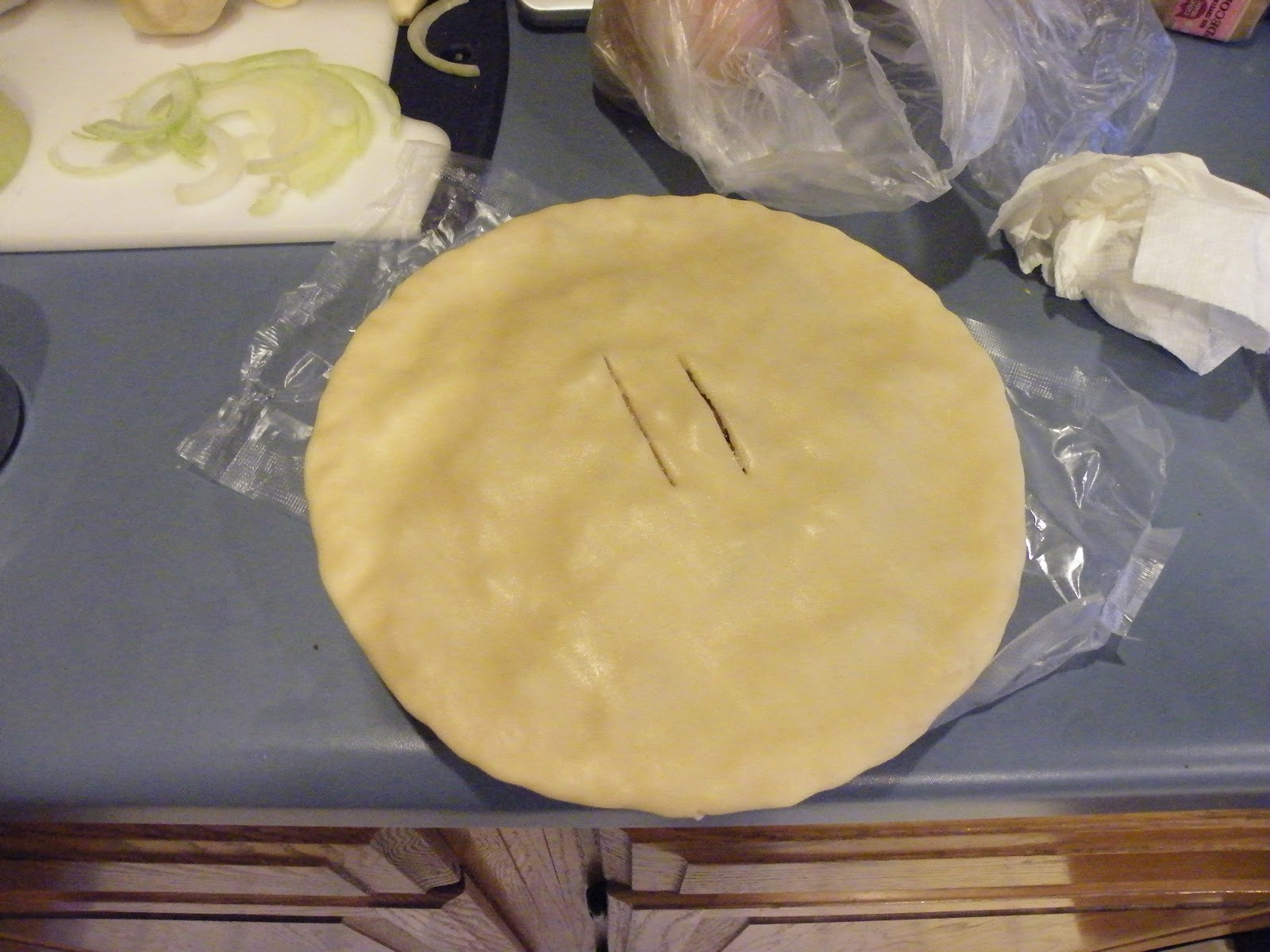
    Spoon the mixture into a pie crust, cover the top with crust, crimp the edges to connect the two pieces, and cut slits in the center of the pie to allow for steam to escape.  Bake pie in the oven at 425* for 20-25 minutes, or until the crust is golden brown.

Recipe courtesy of Mrs. Patience Wood

Wednesday, December 21, 2011

Recycling Your Squirrels: Fur

   
    For fly tiers like myself, squirrel fur can be a very frugal substitute to the conventional rabbit fur dubbing that can be purchased specifically for fly tying.  Squirrel fur is suitable for fly tying and has been emerging on the market in the last several years as a cheaper alternative to rabbit.
    Before you can begin making squirrel dubbing it is necessary to have a preserved skin to work with.  When skinning your squirrel, begin under the tail, make a long cut up the center of the belly to the shoulders, and make four diagonal cuts along the inside of the legs to the feet.  Nail the raw skin, flesh side up, to a piece of plywood with finishing nails and apply a generous amount of salt to pull moisture from the skin and keep it from rotting.  After a few days, scrape the salt from the skin, and remove from the board if dry.  If the skin is still moist, repeat the salting process.  You now have a preserved squirrel skin that can be reused until all the hair is used.
    First, the method that provides the highest quality dubbing involves a bit of machinery.  Using your hands, or a wire brush, gather a good amount of squirrel hair, including both the underfur and the guard hairs.  After you have gathered enough fur, run water over it to prepare it for the next step.  Next, use a blender on the pulse setting to blend your squirrel fur to the desired consistency.  After blending, fluff the fur out by running it through a grinder and allowing it to dry.
    The easy alternative to the blend and grind method above takes relatively no time at all.  Just pinch a good handful of underfur, and a few guard hairs from the dried skin, mix, and store in a handy pill bottle.
    Without any coloring, natural gray squirrel dubbing is ideal for fly patterns requiring gray dubbing such as the Adams, Adams Parachute, and Mosquito patterns.  Just like with rabbit fur, squirrel fur can be dyed to accompany any popular fly pattern.

Saturday, December 17, 2011

Recycling Your Squirrels: Tails

 
    So you've limited out several times this year, or at least killed several bushytails, and you begin to realize how much of the animal you are actually using when you clean them and freeze them for later, and you wonder what you could be using the rest of your squirrels for.  Just like with deer, there are several things you can do with a nice squirrel decides eating it.  A series of posts following this one will introduce new ways to use other parts of squirrels, and a few recipes will fall among them too.
    To the tree squirrel, their tail is a very important anatomical feature that gives them balance and leverage in the upper reaches of tall hardwoods--to the average hunter, it usually goes in the gut pile.  If you routinely kill numbers of squirrels, it may be beneficial to keep these bushy appendages around.
    The number one spinner-fly company in the world, Mepps Lures, knows the value of squirrel tail, and it has shown in their domination of the fishing industry.  After trying countless animal hairs, squirrel tail provided the results the tackle crafters were looking for, and the spinners produced and sold by the company today are still made with natural and dyed squirrel tail.  If you are not into tackle craft or fly tying, for which it is also a staple ingredient in many streamer patterns, you can mail your collected and dried squirrel tails to the Mepps headquarters in Wisconsin in return for a small payment.  Here is the link to the page on the Mepps website:  http://www.mepps.com/programs/squirrel-tail/.
    Even if you have no interest in preserving or reusing tails, or you only harvest the occasional squirrel, kids sometimes appreciate having a squirrel tail around as a token from the outdoors.  I got my start in the hunting world as a toddler accompanying my dad in the mountainous part of the state, chasing bushytails, and cleaning them by the river, and my most prized token from that time in my life is a tanned squirrel hide that my dad made for me.

Sunday, December 11, 2011

Shotgunning for Late Season Bushytails

    
    This Saturday was going to be another day in the deer woods for me, but when I got the call from my neighbor around 2:00 in the afternoon, the wind had picked up, and I suddenly reflected on the fact that I haven't seen, or gotten trail cam pics of a deer in over a month--I was going squirrel hunting.  My twenty gauge was still laying on my bed, begging for use--I couldn't refuse.
    Entering the woods on a hilltop full of white and red oak trees, several large squirrels made dashes for cover, I dropped one, and pocketed him after just two minutes in the woods.  I could tell right away this would be easy.
    After shooting once with the loud boomstick, the resident squirrels that were still alive were holding tight, and they were not budging, so I moved onto another quadrant of the hardwood portion of the property.
    After an hour of ridge hopping, I had five puffy squirrel tails hanging from my game pouch.  I needed one more bushytail to limit out--that wouldn't be a problem.  My plan was to hit the second ridge I hunted once more, because the squirrels seemed to be on the ground here, and I had the sun to my back, making stalking easy.  As I quartered up the ridge, I pushed a wary squirrel around the top of the ridge, so I stayed put, hoping he would return to his food source.  My plan proved effective as the small gray pounced our from behind a tree two minutes later, I ended his dinner plans with a solid bark from the twenty gauge--mission accomplished.

Sunday, November 27, 2011

Paying My Respects

    I set out into the woods one day last week after school to try to collect a few more Bushytails before I left for the week.  The sun was high, and the sky clear.  I decided to try the neighbor's property, because he had made a comment earlier in the season that he could see more than fifteen squirrels from his deer stand without shifting his glance.  Its too bad I can only take six.
    Just on the inside of the treeline, I spotted movement in the crowns of several Red Oaks.  All of the squirrels seemed to be mature, and I quickly set myself up with a rest on a solid White Oak.  The animal closest to me, a thick veteran of squirrel season, settled in a crotch of a tree behind a veil of dead twigs.  I waited for the alarmed yearlings to stop scampering about and chattering before I began coaxing my quarry from his perch.  A few chirps that I created with my mouth got him curious, curious enough to poke his head out from his hiding place.  He may have been a veteran of the fall woods--but so am I.
    Toting the head-shot rodent by the feet down into the creekbottom, I spotted another hefty Bushytail feeding at the base of a pine tree.  Stalking downhill, I kept a thick oak between me and my quarry, and I had the sun to my back, so the squirrel's back was to me.  Stopping at just inside twenty yards, I used an ancient White Oak for a rest, and pulled a shot off.
    At first I thought I'd hit him, because he fled scrambling, low to the ground, out of view.  As I followed, I spotted a gray back in a log jam--I froze.  Presuming him to be spent, I approached him, still with caution and alertness.  At a new angle, I could make out his head, and could tell that he was definitely not dead, but as I shouldered my air rifle to take a final shot, he shot from his hiding place, bounding high, to the backside of a thick Hickory tree.

    More alert now, I used the soft creekbottom to my advantage, stalking the squirrel's hiding place almost soundlessly.
    If you've ever chased Bushytails in the bare-boned winter woods, more than likely you've run into a squirrel that disappears behind a mature hardwood, never to show itself to you again.  Sometimes he escapes by means of almost foreign stealthiness, sometimes by squeezing into a tiny hole in a tree trunk, and sometimes still by simply freezing spread eagle against the patterned bark of an oak tree--camouflaged like a hairy Chameleon.
    As I approached the base of the Hickory tree with no response from the squirrel I hoped to find there, I knew I had been outwitted.  I stepped back, searching the crown and crotches of the tree for the one I was seeking.  Pressing my ear to the trunk, I listened for the soft scratching of the Gray's sharp claws on the bark--but heard nothing.  Standing in disbelief, my eyes averted to the sky, then to the ground--it was then that I noticed the hole at the base of the tree.
    As I did once trying to photograph a woodchuck, I quartered around the trunk, and took a prone position on the wet forest floor.  Ten minutes went by, and the squirrel never appeared.  Stiff, and wet, I got up and brushed myself off.  I made my way over to the tree, maybe to pay my respects to an animal that had outsmarted me, but I'm not really sure why.  There, laying in the entry to the den hole lay the squirrel I had chased all afternoon--lifeless.

    Maybe it was unfit, but standing there, in the fading light, I was filled with pride, and respect.  A hunter's job, or goal, is to beat his quarry at their own game--in their element, by their rules,completely beat by the odds.  I had done just that.  The Bushytail I now admired had put up a daring fight, and admitted defeat only when it was decided, and even offered himself to me when it was over.  Thinking this through in my mind, I climbed the hill back home with a much greater respect for one of my favorite game animals--he may have been a veteran, but so was I.