Thursday, February 12, 2015

SQUIRRELS AND RABBITS STILL LEGAL

In early February, the out-of-doors can be an inhospitable place, and with deer season long concluded, many outdoorsmen hang their hat and dream about spring by the fire.  However, thanks to last year’s regulation amendment, squirrels remain in-season with rabbits, until the last weekend in February.  Pursuing either may provide enough adrenaline to ward off winter’s chilly advances.

Photo by Matt Reilly


Two Triples

    
    After a 25-fish morning on a Blue Ridge brook trout stream with my older brother, Phillip, I embarked on my drive home with the sun in my eyes.  The warm mid-day sun had raised the mercury almost 20 degrees since dawn, and I knew the woolly bushytails in my favorite woodlot would be drawn up into the hardwood canopies to soak up the rays.  My trigger finger itched, and I pressed a little harder on the gas pedal.

    Dead oak leaves crunched under my boots with just a few hours of daylight left.  I couldn’t blow any shots and expect to leave the woods with my limit of plump squirrels.  Luckily, I thought, with the winter mating season in full swing, my quarry would be a bit distracted.  Sneaking to within range of a playful bunch might present multiple shots for my 20-gauge scattergun.

    I crossed a small creek at the base of a ridge and paused, listening for activity.  Nothing.  Continuing up the ridge on heel and toe, I made two steps before a gray missile bolted from the trunk of a white oak and began scaling another.  I shouldered my shotgun and landed the bead on the hesitating, spread-eagle gray.  A squeeze of the trigger cashed #6 shot for the evening’s first bushytail.

    I hadn’t shucked the spent shell before two more squirrels fled from the creekbottom.  One made an acrobatic attempt to find safety in an adjacent tree, and a report from the 20-gauge dropped it as it struggled for footing.  The other made an athletic departure along a fallen oak tree, but the third and last shell in my chamber stopped it short. 

    A half hour later I found myself running out of light.  At the base of the next ridge, I could hear the scampering of multiple squirrels in the dense creekbottom, hidden only by a small rise.  When I was sure they were distracted with each other, I closed the distance to a wide oak trunk over the rise in quick bursts, imitating the sound of a pouncing bushytail.

    The first shot was presented when an alarmed gray jumped from the trunk of an oak into the branches of another.  Peeking around my temporary cover, I took aim and sent it tumbling.  The next peeked around the base of another oak, presenting a head shot that didn't go unclaimed.  A third held tight on the forest floor for several seconds before making a mad dash up the nearest hickory tree.  I ran forward ten feet before he began his assent up the trunk and, taking a quick knee, fired a rising shot for a second triple and the last of my limit.

Rabbits in the Open

    
    It was in the final week of the 2012-13 deer season that I was perched high in a tripod overlooking a food plot of clover, radishes, and alfalfa.  The green lanes were cut from the surrounding pine and rose thicket, which I knew to hold scores of cottontails.  In fact, it was rare that I made the walk to my stand without jumping a rabbit or two, and any time spent in the camouflaged perch was likely to see regular bunny traffic coming to the wood’s edge to feed on leafy greens.
    
    A .22 in the place of my .243 would have filled the pot, but instead, at a later date, I approached the thicket with a shotgun and small game loads.  Countless rabbit trails emerge where the pine-needled edge meets grass, so I surveyed for concentrations of traffic before diving into the tangle.

    Once inside, potential rabbit hide-outs are easy to spot.  Bent over cedar trees, hollow logs, rose bushes, tree piles—each should be approached, gun at the ready.  I proceeded in this manner for two hours, and jumped a total of five cottontails.  In each case, it escaped without injury with no shots fired.

    It is typical of spooked rabbits to return to their individual piece of cover when danger has moved on.  However, keeping a tight eye on return routes, I could detect no movement after several minutes of waiting. 

    Regardless, there is no better way to jump-start your heart in the frozen February woods than with the spirited exodus of a fleeing rabbit.  With any luck, next time’s score will lean in my favor!□

Originally published in the Rural Virginian 

Wednesday, February 4, 2015

ADVENTURES UNDERGROUND

And there it was—the feeling that all had not been explored, that there is potential for virgin country in our American backyard.  Modernity lends us this injustice, that six centuries after the age of exploration, we must strive to escape an urbanized globe and find ourselves outside the reaches of roads, noise pollution, and fellow wanderers to achieve a consensual ignorance in which we lead, if only for an afternoon, an exposed, wild existence.  And then it hit me, as a kiss from an overhead stalactite.

    Below the bi-state city of Bristol, a small tributary to the South Holston River gurgles out from a rocky bluff in a hardwood hollow.  Rural countryside greets its escape from the hollow—a landscape that fails to suggest what lies in the trickle’s headwaters.

    That particular headwater I, along with a group of nine, traced into the mountain—or rather under it.  A wall of warm, stagnant air hit our faces as we ducked beneath a low ceiling.  With that, donning hard hats and headlamps, we were inside the best natural spelunking cave east of the Mississippi.  Exploration was not lost.

    As we were warned prior to takeoff, the setting is a living, wet cave, still forming as minerals drip from the cave ceiling and stalactite canals to the floor, creating pillars and mounds and a generally muddy surface composition.

    Old clothing is the uniform of champions here.  Not in the “wear old clothes in case they get dirty” sense, but in the “they will be ripped, punctured, shredded, soaked, and muddied beyond belief” sense.  Old work pants and a cheap sweatshirt or long-sleeve t-shirt are prime choices.  A synthetic base layer is optimal, along with your choice in synthetic socks.  Shoes should provide adequate protection and traction.  Boots and old sneakers are good choices.

    Within seconds we were on all fours.  Mineral formations don’t oblige body types or skeletal structures.  To progress, we were forced to take shapes, to solve the problems faced, physically.

    After much ducking and crawling, we came to a cliff—an underground mountain of sorts.  Our guide promptly climbed the boulders to the peak, where the chamber continued deeper into the ground, tied off a rope to a triangular rock, and tossed down the hand line.  We repeated this process twice, over two rises, those in the rear chocking the feet of those ahead and spotting as they made the ascent gripping the hand line.

    Because of these situations, being guided as a first-time spelunker is strongly-encouraged.  As one might imagine, spending time underground is dangerous--even more so without any prior experience or training.  Thus, the best way to explore a living cave is through a guide service or caving club, or “grottoe,” associated with the National Speleological Society.  They will be informative and skilled, warning against harming the fragile cave ecosystems and helping to prevent the spread of issues such as white nosed bat syndrome.

    At that time, we had reached the upper level of the cave.  Along the way we took our time in exploring tight spots, which did and did not lead to other rooms; most passed through walls or under the floor to reemerge again. 

    When in such a position, where one can literally not move to the left or right, but difficultly forward and backward, it’s surreal to attempt to observe the scene out of context.  To the average earth-dweller, who inhabits a house or apartment, who exists in the sunlight each and every day, and who makes their tightest squeeze when passing through a door jam or cars in a lot, a two-foot tunnel of living rock below a river and fathoms of earth and mountain is a foreign place to wind up.

    Yet, adrenaline seems to limit reflection or fear in such places.  For, with your arms stretched forward over your head, it’s amazing what crevices a human can navigate.

    As we began our descent, we came upon a hole.  Though hidden by a 12-foot mound, it was perhaps five feet in diameter, and extended downward a few hundred feet.  Crawling over the mound, we crab-walked down the chute until the slope grew steeper and sliding became the effective motive of transport.  One steep downhill turn, and we landed knee-deep in an underground river!

    In the dark, wading perception becomes difficult, particularly with others clouding the water.  So we remained in a straight line, sending clues up and down the line.

    After nearly a half mile of river channel had been covered, we found dry (ok, muddy) land again, and promptly climbed into a slot roughly 10 feet wide by two feet tall and 80 feet long.  An 80-foot roll commenced, and when we were finally upright again, a foreign light penetrated the darkness in our dizzied state.


    The sun.□

Originally published in the Rural Virginian

Thursday, January 29, 2015

GETTING AHEAD OF LEAD

Outfitting oneself for the field is hardly an operation lacking technical options.  Terminal tackle—hooks, sinkers, etc.—and ammunition are no exception.  In recent years, tackle and ammunitions companies like Water Gremlin and Remington have begun to introduce eco-friendly sinkers and shells made of lead alternatives, like steel and tungsten, as a response to the rise in awareness of lead-related environmental effects.

Virginia has yet to see any specific lead tackle bans.  However, other states have placed state-wide bans on the use of lead sinkers; and the country, a ban prohibiting the use of lead shot by waterfowl hunters.  Ban or no ban, the responsible outdoorsman has an obligation get a lead on lead poisoning and support a healthy environment in any way possible.

    The state of California has made very clear the ill effects associated with lead; but why is it dangerous to wildlife?  The foremost biological concern is waterfowl mortality via an illness called lead toxicosis.  Lead toxicosis occurs when the lead concentration in the liver surpasses five PPM.

    According to the University of Vermont, the common loon, an endangered species in the state and the most common victim of fatal lead toxicosis in New England, can be killed by a single dose of only .3 grams of lead—the weight of even the smallest pinch-on sinkers.  Three decades ago, prior to any national lead-regulating laws, waterfowlers blanketed America’s wetlands with 5,997,084 pounds of lead shot pellets annually, or, pretending for a moment that each of these pellets weighed .3 grams, 9 billion potential loon-killers.

    With all that lead in the water, it’s no doubt that waterfowl were suffering.  Waterfowl have no teeth; and therefore, must ingest their food whole.  After eating, a small stone is swallowed and enters the gizzard to grind up food as part of the digestion process.  This is how lead toxicosis becomes a problem for our feathery friends.  A small piece of lead shot or a small sinker look similar to stones, and are commonly ingested by birds who mistake them as such.  The consequence is usually fatal.

    Finally, in 1991, lead shot shells disappeared from the waterfowl hunting scene following a ban the EPA placed on their use.  Five years after the ban was enacted, a studyconducted in the Mississippi flyway found that the number of cases of lead toxicosis in adult mallards had decreased an estimated 64%, totaling 1.4 million ducks spared from the fatal disease.

    Finding positive results after banning lead from our wetlands, it was only natural to seek out any other ill effects lead shot could cause.  Of course, waterfowl hunters were responsible for littering marshland with shot, and ultimately for a high number of bird mortality.  But what about shot dispersed by small and big game hunters?

    On firm ground, those suffering from lead poisoning are not the hunter’s quarry; and they become poisoned by another pathway.  Game animals that are shot with shotgun shells filled with lead pellets and are never recovered lay in the field to decompose, meaning two things:  a) an easy meal for scavengers and b) tainted meat.  Scavengers in Virginia included endangered birds of prey such as the peregrine falcon and bald eagle; and endangered bird species feeding on poisoned meat equals yet another reason for concern.


    As of yet, Virginia has no law against lead shot for general hunting or fishing tackle; but there are plenty of eco-friendly options available.  Steel and bismuth are common shot alternatives; and bead heads for flies and sinkers are manufactured from tin and tungsten.  All are readily available and are affordable options for the sportsman who desires to preserve and protect the Earth we were given.  There is an old saying that goes “, We do not inherit the Earth from our ancestors, we borrow it from our children.”  Bear that in mind.

Originally published in the Rural Virginian
Wednesday, January 28, 2015

VOWA SEEKING ENTRIES FOR HIGH SCHOOL AND COLLEGIATE OUTDOOR WRITING AND PHOTOGRAPHY CONTESTS

For the 22nd year, the Virginia Outdoor Writer’s Association (VOWA), along with its contest sponsors, Bass Pro Shops, Dominion, VirginiaCooperative Magazine, and Hunt’s Photo & Video is holding two writing contests, one for high school-aged students and one for undergraduate college students.

High School Contest


    The high school contest,sponsored by Bass Pro Shops, is open to any public, private, or home-schooled student in grades 9-12.  Essays should be written about a memorable outdoor experience, with possible subjects including hunting, fishing, camping, boating, hiking, birding, or another outdoor activity.  Accounts of athletic events are specifically excluded.

    Three winners will be selected and invited the annual VOWA membership meeting in Charlottesville on March 21 to present their essays.  The deadline for the contest will be February 16. 

    Prizes provided by Bass Pro Shops will be $150, $100, and $50 gift cards for first, second, and third place winners, respectively.

    For more information on the high school contest, visit www.vowa.org.

Collegiate Contest


    In cooperation with Dominion, Cooperative Living Magazine, and Hunt’s Photo & Video, VOWA is once again offering a collegiate levelwriting and photography contest to any student at any Virginia university or college, including community colleges, two-year schools, and private institutions.  Virginia residents enrolled at out-of-state schools are also eligible.  The topic for the writing contest will be a memorable outdoor experience or special interest. 

    Entrants in the “Best Outdoor Photo” contest, sponsored by Hunt’s Photo & Video, are encouraged to enter up to three of their best outdoor photos in JPEG format, accompanied by a 50-75-word description. 

    Winners will be selected by a judging panel and invited to the annual VOWA membership meeting in Charlottesville on March 21.  The deadline for all contests will be February 16. 

    Each entrant of the contests will be given an annual student membership to VOWA.  The winner selected for the best overall essay will be awarded a $250 cash prize by VOWA-Dominion.  Cooperative Living Magazine will select one winner for the best essay related to outdoors in Virginia and award a $100 cash prize and publish the essay in the magazine.  “Best Outdoor Photo”, as decided by Hunt’s Photo & Video, will be awarded a $50 gift card to Hunt’s.


    I often am faced with the question, “How does one become an outdoor writer?”  The answer is complicated and dependent on a host of factors.  However, one factor is common across the board—credentials.  Before any editor or publisher will be willing to give you a shot, generally, one must prove ability and/or knowledge.  This is at least difficult to youth or young adults without any prior experience in professional writing; and so the best options for earning a first gig, without first organically wearing down a market with hundreds of rejected query letters, are to 1) get to know someone in an editing, publishing, or writing position, and 2) make your name known in the outdoor writing field.

    If you can’t tell where I am leading by now, I’ll make it easy for you.  This contest, should you win at any level, provides both of these opportunities.  Winning will make your name known to those in the local outdoor writing community, and you can forever introduce yourself to an editor as an “award-winning outdoor writer.”  Moreover, you will be invited to attend a meeting in a room full of outdoor writing professionals, all of which are full of knowledge and the mission of recruiting young communicators.  So, if you are interested in outdoor writing in the slightest, this contest is for you.

    Still, should you enter and not win, and you are serious, come to the meeting.  Shake as many hands as you possibly can.  Collect business cards.  Take members up on their offers, suggestions, and invitations.  You will not leave empty-handed.  VOWA is a resource.


    Thus I conclude my annual plug for the writing association that started it all for me.  I do it out of gratitude to the men and women that comprise VOWA, and to everyone that has supported me; but more importantly, I do it out of a desire to see more youth members involved.  The younger generation cannot expect outdoor writing to remain strong, advocating for the continuation of the treasured passions and traditions we all enjoy without recruitment of strong voices.  I suppose that is why VOWA established, and continues to sponsor, this contest.  I hope to see everyone interested in March.□

Originally published in the Rural Virginian

Thursday, January 22, 2015

PHOTO UPDATE: EAST COAST ADVENTURE--TULPEHOCKEN CREEK TO ROSCOE, NEW YORK

Roscoe, New York, the self-proclaimed "Trout Town USA," greeted me on a crisp early fall evening, after a solid five hours of driving.  I could hardly contain my excitement as my veins flooded with adrenaline and the thought that I had finally made the pilgrimage of angling tradition.


Created with flickr slideshow.


    Bridge after bridge, and famed river after river tore at my mind as I ran down Highway 17.  The Beaverkill, the West Branch of the Delaware, the Neversink, Willowemoc Creek--to the newcomer, the feeling is something comparable to being starstruck.
    
    I found my way through town, almost to Livingston Manor, the small but dense post-office town that lies just east of Roscoe, and set my boots on the plywood floor of a bunkhouse in the wooded lot on the peripheral property of the Catskills Fly Fishing Center.  Resting on the bottom bunk for a moment, clad in jeans and heavy flannel for the reduction in temperature since 10:00 AM on Tulpehocken Creek in central Pennsylvania, I had made it.

    Now the three days that followed were plagued by hot weather and low water, not without the added surprise of the 20th annual Catskills Bamboo Rodmaker's Gathering.  I did manage to snap a few photos, though I rarely took out my Nikon--the majority of these are Iphone and point-and-shoot photos.  I apologize (kinda) for the less-than quality, though to me these images recount an experience that well makes up for it.

    Enjoy!□

Wednesday, January 21, 2015

TRACKING: HUNTING AFTER THE SEASON IS OUT

Throughout my youth I regularly divulged in enrapturing trips, daydreams colored by the nostalgia- and adventure-soaked glossy pages of the classic Sports Afield and Field & Stream that appeared in my mailbox monthly.  Many of the faraway adventures highlighted in such publications outran the growing range of my mountain bike in my pre-driving years, namely the annually-published how-to’s and accounts of “big woods” whitetail tracking.  Benoit, the fabled, north-country whitetail tracker and writer routinely caught my jealousy, and inspired in me an appreciation for the industrious and fine art of tracking deer in the snow.
Photo by Matt Reilly.
    But I had little opportunity to hop aboard a plane and head for the “north country” wildernesses of the Adirondacks or Green Mountains at 10 years old, as neither my budget nor my attendance record at school would allow it.  Moreover, dependable winter blanketings are not typical of the general firearms season—they come later, in the height of the winter.  Still, as I have found time and time again, increased sporting opportunities present themselves when one is willing to trade in their gun for a camera and chase game after the season closes.

    My chance came some six or seven years ago in the event of a first heavy snow, arriving sometime around mid-January.  Throughout the deer season, for fun, I had been maintaining a trail camera on a vacant woodlot adjacent to our subdivision home and capturing images of some resident whitetails.

    The light in my head clicked as I checked the images on the camera the morning after a snowfall of almost 12 inches.  The same bucks were moving, frantically, early in the night, before the snow, and continued to trigger the camera as inches accumulated.

    The next morning, determined to find tracks from the bucks, I ventured out into the cold, high-stepping, with my Nikon in hand.

    The site of the camera showed sign of tracks, though merely a string of indentations filled in by the fresh powder.  Following them, as they weaved in and out of successional pines and shrubs, I quickly came upon what looked to be a fresh bed—an ovular patch of wet leaves and melted snow beneath a small leaning pine.  The tracks redirected at the bed and continued on—this time more defined in shape and devoid of fresh powder. 

    Mental images taken from the pages of my magazines and books, allusions to the “north country” fantasy I had by then begun to entertain, filled my mind and excited my pulse.

    Now as I approached the bed and the exiting track, I could see the trail shoot off into the more open grove of the vacant woodlot deliberately, rarely straying from a straight course.  As I followed it, I could tell by the cleanness of the tracks and the depth of the snow (and the difficulty I was having walking in it) that the animal could not be too far ahead, but scanning the scene one, two, and three times presented no glimpses of my unknown quarry.

    Taking care not to step on the tracks should I have to retrace my steps, I continued on to the edge of the open woodlands, where thicker brush met the hardwoods in a creekbottom.  Immediately inside the thicker cover, the track began to meander around logjams, under deadfalls, through thickets.  

    Luckily, I had the presence of mind to recognize what had occurred in the snow mere moments before.

    Aware of the storm rolling in through the night, the deer took cover in the pines behind the house.  The frantic escape from its bed was likely the result of the presence of danger, which inspired the animal to flee the thicket, dash through the open cover, and look for cover in the creekbottom.

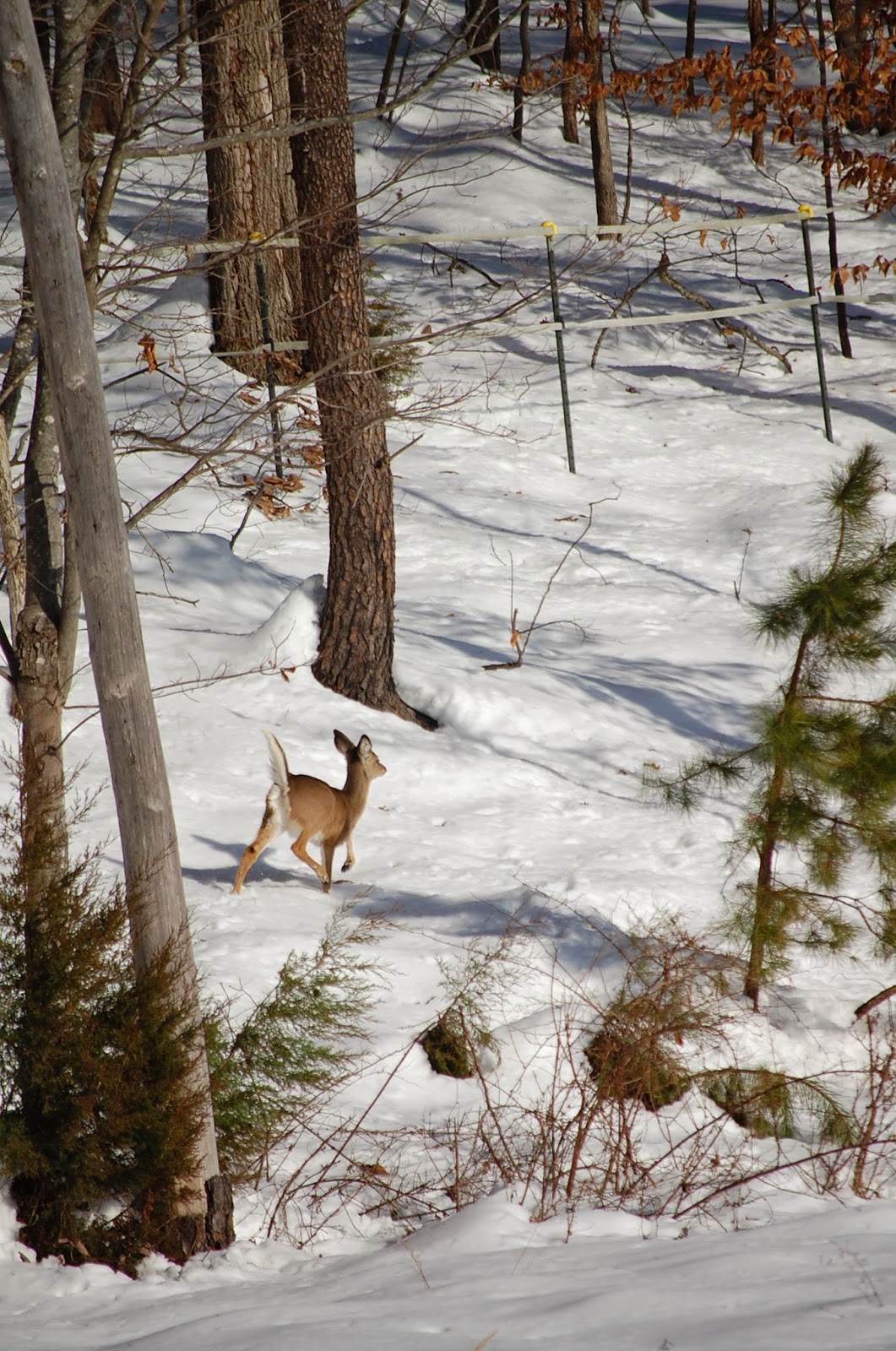
    As I comprised this replay in my mind, I stood still, staring off into landscape, oblivious.  Totally unbeknownst to me, my target sat in hiding mere feet away from my position and, sensing my hesitation and believing her cover compromised, dashed from cover and trotted into an open field adjacent to the creekbottom. 


    My reflexes flinched and my camera was raised and the shutter pressed.  The shot I captured was less than perfect, though I was ecstatic to realize that had I been probing the wilderness of northern Vermont in the height of deer season, my actions may very well have earned me a deer and the accomplishment of downing my first snow-tracked whitetail.  Ever since, when the air turns cold and the landscape white, and deer season in long gone, I push myself through the doldrums of winter replaying that north-country fantasy.□

Wednesday, January 14, 2015

THE 2015 OUTDOOR SHOW SEASON IS HERE!

With the onset of the New Year and the expiration of deer season, the doldrums of winter are officially upon us.  However, there is a beginning in such a dramatic end.  The 2015 outdoor show season has arrived!  Outlined below is this year’s detailed schedule of events relevant to Virginia sportsmen.

Jan. 16-18—Richmond Fishing Expo


    For the eighth year running, the Richmond FishingExpo is returning to the Farm Bureau Center at Meadow Event Park in CarolineCounty.  This is a family-friendly show intended to be fun and educational to all in attendance.  Featured exhibitors include an array of guide services, outfitters, tackle companies, conservation organizations, and marine dealers.  An impressive lineup of professional angling personalities, including John Crews, Davy Hite, Britt Stoundenmire, John Hutchins, Chris McCotter, and Brian Oxendine, are presenting seminars over the course of the three-day event.  The price of admission covers all three days of the expo, so plan to return to restock your tackle boxes and soak up all the knowledge that will be floating around the Farm Bureau Center on this much-awaited weekend.

Jan. 30-Feb. 1—National Capital Sportsman Show


    Held in the 80,000+ square-foot FredericksburgExpo Center, the National Capital Sportsman Show is a family-oriented event that provides outdoor enthusiasts prime access to the industry’s leading products, outfitting services, and personalities.
   
    The show is the venue of the coveted National WildTurkey Federation Virginia State Championship Turkey Calling Contest, to be held at 12:00 noon on Saturday, January 31.  Pre-registration is suggested for the open, intermediate, friction, and JAKES youth calling contests.
Special guests of this year’s show include local Fluvanna County boy and host of the Outdoor Channel’s Red Arrow TV series, Kip Campbell, and the crew from Buck Obsession.  Come out and enjoy this weekend of interactive and educational fun!

Feb. 14—Rapidan Chapter Trout Unlimited FishingShow


    If fly fishing is your game then you won’t want to miss “the biggest little fishing show” in northern Virginia, held annually by the Rapidan Chapter of Trout Unlimited at the Fauquier County Fair Grounds.  This event is the fundraising project for the organization’s conservation efforts, annual youth conservation and fishing camp, Trout in the Classroom programs, and the Virginia Heritage Day.  A lineup of authorities like Colby Trow, Capt. Ed Lawrence, and Walt Cary are scheduled to present on everything from saltwater fly fishing to building poppers.  A host of raffle prizes, ranging from an all-expenses-paid trip to Yellowstone National Park to rods and flies keeps attendants on their toes.

Feb. 20-22—Western Virginia Sports Show


    The 28th annual Western Virginia Sports Show at Augusta Expoland features an exciting lineup of outdoor TV personalities; and this year’s show boasts more than ever before.  Special guests include Bobby Brantley of Bad Dog Nation TV (formerly of TruTV's Lizard Lick Towing); Paul Butski, 3-timeNWTF Grand National Turkey Calling Champion and 6-time US Open Turkey callingChampion; Reed Merideth of Wicked Tuna:North vs South TV, and Don Shumaker from Buckingham, who will be doing seminars on coyote trapping and hunting.

Feb. 28-Mar. 3—Orange County Sportsman Expo


    In its 11th year being held at the Orange County High School’s Hornets Sports Center, the Orange County SportsmanExpo is the product of the hard work of the  "Nation's Outstanding Junior B.A.S.S. Federation Nation Chapter", the Orange County High School 4-H and B.A.S.S.Angler's Club.  Exhibitors include hunting and fishing guides, wildlife artists, taxidermists, and more.  Come out and support the Orange County High School Anglers!

April 11-12—Virginia Fly Fishing and Wine Festival


    Now in its 15th year, the Virginia FlyFishing and Wine Festival held on the banks of the South River at ConstitutionPark in downtown Waynesboro features an array of exhibitors, including fly fishing guides, artists, conservation organizations, fly tiers, and product developers.  This event features renowned personalities such as Lefty Kreh, Ed Jaworowski, Fishy Fullum, Walt Cary, ColbyTrow, and more.  Interested in discovering the new world of tenkara fishing?  Come see tenkara fishing guide Tom Sadler’s introductory presentation.  Is kayak fishing more your speed?  Cory Routh of Ruthless OutdoorAdventures will be conducting ongoing on-the-water demonstrations!  Come join the fun!

Originally published in the Rural Virginian□