
A fire burned on jagged mountain crests above the landscape
of a reclaimed strip mine, from within the crimson and apricot leaves of
expiring hardwoods. The setting sun painted a halo of orange on the pointed
peaks, topped by the glowing pale blue sky of an early-to-rise hunter’s moon, casting
silhouettes of mountains and coal fields spanning west into Kentucky, north
into West Virginia, and south and east into the more populous regions of
southwest Virginia’s Mountain Empire.
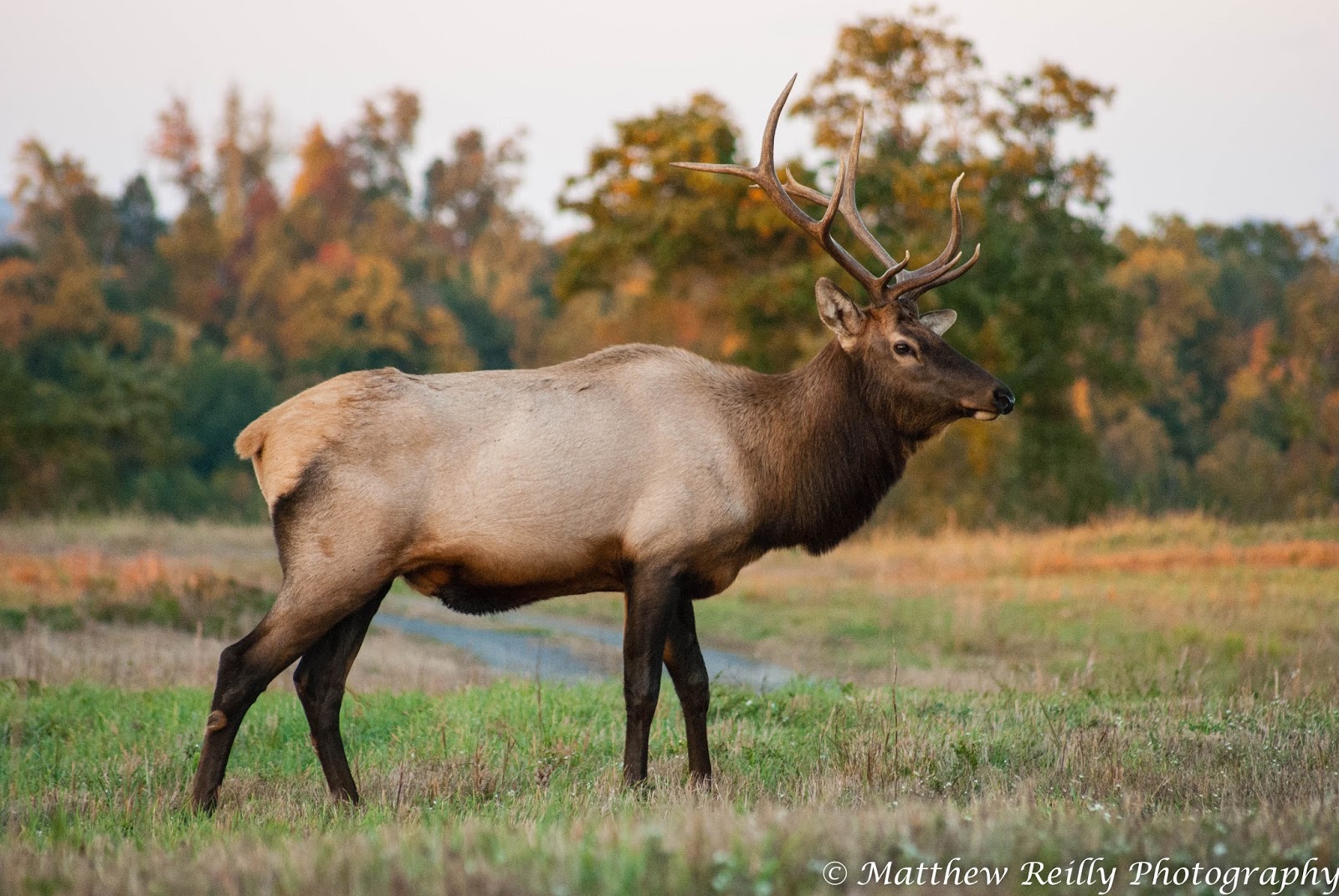 |
| 5x5 bull elk taking stock of his field in Buchanan County, Virginia. Photo by Matt Reilly. |
After glassing from an opposing mountain vantage point and
driving hurriedly over gravel and tall grass, John Taylor of Vansant, Virginia,
a volunteer with the Southwest Virginia Coalfields Chapter of the Rocky
Mountain Elk Foundation (RMEF), brought his lifted, dark emerald Excursion to a
grumbling halt, eyes fixed on a few dozen hide-colored bobs populating a
rolling fescue field.
I’d been there before, and recognized the terrain bathed in
clear moonlight and the palpable feeling of natural history in the making. Only
this time, the mood was much wilder. My previous visit was two and a half years
ago. At 2:00 in the morning, I stood in the company of Virginia Department of
Game and Inland Fisheries (VDGIF) staff and RMEF volunteers—their eyes glued to an enclosure, on
which headlights born of Kentucky would soon appear hauling a livestock trailer
containing 45 of the hide-colored bobs.
That young April morning of 2014 marked the last installment
of a three-year plan to restore elk to the state of Virginia. A subspecies of
elk, the eastern elk, is native to western Virginia, but was extirpated by early
human inhabitants—the last individual killed in Clarke County in 1855. Since
then, in recent history, there have been a few failed attempts at
reestablishing a viable herd in the Old Dominion, but each met a calculable
end. However, the 72 Rocky Mountain strain individuals trucked in from Kentucky
to the reclaimed strip mine site in Buchanan County, and protected within the
designated “restoration zone” of Buchanan, Dickinson, and Wise Counties, has
shown tremendous success, and now boasts a herd of 160-165 individuals.
Camera cradled, I climbed from the Expedition, followed by
Taylor, and stalked quietly behind a screen of brush to subtract twenty yards
from the distance separating us from the elk. Light was insufficient for my
camera, but I already had pictures. I found more light through the glass of my
binoculars.
The hide-colored bobs grew hide-colored ribs and shoulders;
cinnamon bellies and legs; and shaggy, chocolate manes. Some grew antlers
branching once, twice, three and four times from each main beam. All grew wild
eyes.
Then an old, stately bull emerged from a treeline just over
a fescue knob.
“I’ve never seen him before,” Taylor breathed. “He’s not one
of ours.”
His eyes fell on me, then on the dozens of cows grazing in
the field. The rut is winding down, but the need to breed is still in their
psyche, and he likewise began rounding up a few stray females. He was shaggy,
totally chocolate—almost black—with a 6x6 rack, beams and tines dark, save for
ivory tips.
A few satellite bulls milled about the field, paying more
attention to the dominant bull than to the females in the herd. One younger
bull—a lanky 4x4—was left behind, once the chocolate bull had rounded up his
harem. The dominant bull turned to face him, and slowly began walking towards
the bull, occasionally throwing his rack back and extending his neck, as if to
bugle, but without sound.
The gap between bulls was closed to a few feet. The 4x4
looked puzzled, and the chocolate bull passed him by without incident. As if
told to keep up, the 4x4 then trotted towards the treeline where the group of
cows were exiting the field. The chocolate bull followed suit, and in the
fading light, made a few attempts to mount one of the trailing cows.
The woods just inside the opposing treeline were torn apart
as a massive 7x7 bull charged into the field, pounding the ground with hooves
driven by 700 pounds of muscle, gleaming rack thrown back in aggressive trot.
He charged into the center of his harem, reclaiming ownership, and booting the
chocolate bull from the field and into sexual and social exile in the hollow
below.
Turning to take a visual survey of his territory, his cows
swirled around him as he tossed his headgear back and, with shaggy mane
outstretched, hurtled a piercing, cocked-jawed, guttural screech into the night
that rattled my heart on its arteries like a yellowing leaf blasted by a
November wind. There was crashing and hoof stamping where there hadn’t been for
almost two centuries, and a home-again drama of the autumn woods disappeared as
quickly as it unfolded into the moonlight-cloaked thicket.
*Originally published in the Rural Virignian

