Showing posts with label Fall. Show all posts

Wednesday, October 26, 2016

ELK RETURN TO AUTUMN IN VIRGINIA

A fire burned on jagged mountain crests above the landscape of a reclaimed strip mine, from within the crimson and apricot leaves of expiring hardwoods. The setting sun painted a halo of orange on the pointed peaks, topped by the glowing pale blue sky of an early-to-rise hunter’s moon, casting silhouettes of mountains and coal fields spanning west into Kentucky, north into West Virginia, and south and east into the more populous regions of southwest Virginia’s Mountain Empire.
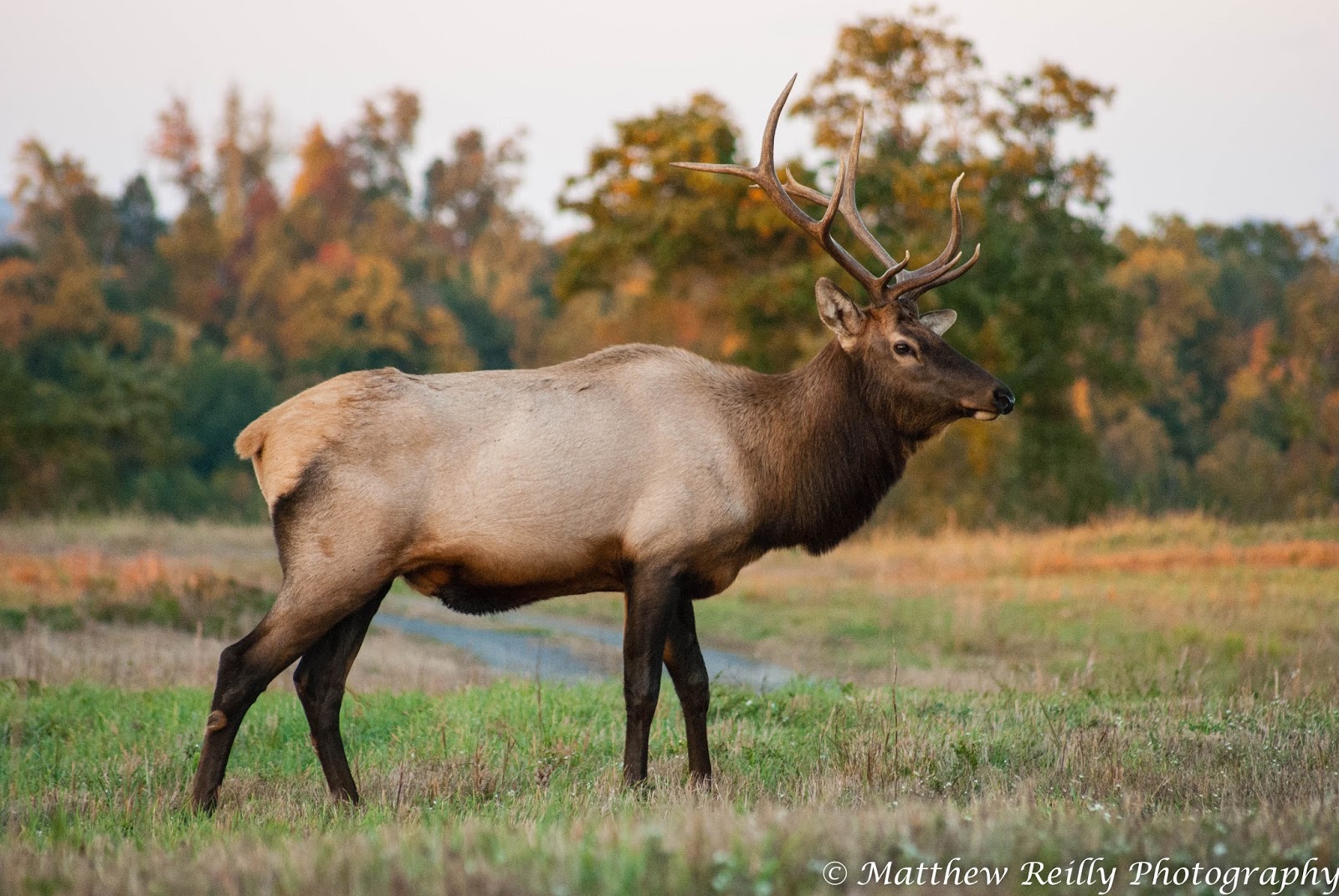
5x5 bull elk taking stock of his field in Buchanan County, Virginia. Photo by Matt Reilly.
    After glassing from an opposing mountain vantage point and driving hurriedly over gravel and tall grass, John Taylor of Vansant, Virginia, a volunteer with the Southwest Virginia Coalfields Chapter of the Rocky Mountain Elk Foundation (RMEF), brought his lifted, dark emerald Excursion to a grumbling halt, eyes fixed on a few dozen hide-colored bobs populating a rolling fescue field.

    I’d been there before, and recognized the terrain bathed in clear moonlight and the palpable feeling of natural history in the making. Only this time, the mood was much wilder. My previous visit was two and a half years ago. At 2:00 in the morning, I stood in the company of Virginia Department of Game and Inland Fisheries (VDGIF) staff and RMEF volunteers—their eyes glued to an enclosure, on which headlights born of Kentucky would soon appear hauling a livestock trailer containing 45 of the hide-colored bobs.

    That young April morning of 2014 marked the last installment of a three-year plan to restore elk to the state of Virginia. A subspecies of elk, the eastern elk, is native to western Virginia, but was extirpated by early human inhabitants—the last individual killed in Clarke County in 1855. Since then, in recent history, there have been a few failed attempts at reestablishing a viable herd in the Old Dominion, but each met a calculable end. However, the 72 Rocky Mountain strain individuals trucked in from Kentucky to the reclaimed strip mine site in Buchanan County, and protected within the designated “restoration zone” of Buchanan, Dickinson, and Wise Counties, has shown tremendous success, and now boasts a herd of 160-165 individuals.

    Camera cradled, I climbed from the Expedition, followed by Taylor, and stalked quietly behind a screen of brush to subtract twenty yards from the distance separating us from the elk. Light was insufficient for my camera, but I already had pictures. I found more light through the glass of my binoculars.

    The hide-colored bobs grew hide-colored ribs and shoulders; cinnamon bellies and legs; and shaggy, chocolate manes. Some grew antlers branching once, twice, three and four times from each main beam. All grew wild eyes.

    Then an old, stately bull emerged from a treeline just over a fescue knob.

    “I’ve never seen him before,” Taylor breathed. “He’s not one of ours.”

    His eyes fell on me, then on the dozens of cows grazing in the field. The rut is winding down, but the need to breed is still in their psyche, and he likewise began rounding up a few stray females. He was shaggy, totally chocolate—almost black—with a 6x6 rack, beams and tines dark, save for ivory tips.

    A few satellite bulls milled about the field, paying more attention to the dominant bull than to the females in the herd. One younger bull—a lanky 4x4—was left behind, once the chocolate bull had rounded up his harem. The dominant bull turned to face him, and slowly began walking towards the bull, occasionally throwing his rack back and extending his neck, as if to bugle, but without sound.

    The gap between bulls was closed to a few feet. The 4x4 looked puzzled, and the chocolate bull passed him by without incident. As if told to keep up, the 4x4 then trotted towards the treeline where the group of cows were exiting the field. The chocolate bull followed suit, and in the fading light, made a few attempts to mount one of the trailing cows.

    The woods just inside the opposing treeline were torn apart as a massive 7x7 bull charged into the field, pounding the ground with hooves driven by 700 pounds of muscle, gleaming rack thrown back in aggressive trot. He charged into the center of his harem, reclaiming ownership, and booting the chocolate bull from the field and into sexual and social exile in the hollow below.


    Turning to take a visual survey of his territory, his cows swirled around him as he tossed his headgear back and, with shaggy mane outstretched, hurtled a piercing, cocked-jawed, guttural screech into the night that rattled my heart on its arteries like a yellowing leaf blasted by a November wind. There was crashing and hoof stamping where there hadn’t been for almost two centuries, and a home-again drama of the autumn woods disappeared as quickly as it unfolded into the moonlight-cloaked thicket.

*Originally published in the Rural Virignian

Wednesday, October 21, 2015

FINDING AUTUMN IN OKEFENOKEE

I get nervous when I lose sight of the mountains. Something about the overgrown, flat, expansive terrain of the Deep South (and something about burning through a tank of gas nervously purchased on the Florida-Georgia line in an hour, too) causes me to lose my bearings and bring my guard up. As I traded blazing maples and conifers for Spanish moss and cypress knees en route to Okefenokee Swamp in south Georgia in early November, the change was evident.

Photo by Matt Reilly.
    Just days before, snow fell on a turkey hunting effort and spiced up the sex drive of brown trout in northern Pennsylvania.  Clouds hid the sun for days on end.  The hardwoods covering the walls of the Pine Creek Valley were barren; it seemed winter had moved in before fall was through unpacking.  However, almost 1000 miles and six states south, the crisp nights of the season so treasured were just beginning.

    Southwest Florida, and the promiseof snook and tarpon fishing amongst a mangrove maze, was on the menu for the end of the week, but with kayak in tow, I couldn’t, in good conscience, pass up the rich paddling potential of the famed swamp.

    That night, after a short walk, I laid my head upon firm ground, yards from the swamp, resonating with the cuckoos and whistles of swamp creatures. The distinct drone emitted by spiraling mosquitos hung in the background, held at bay by the screen of my tent, while foraging gray squirrels rustled the palmettos above. Small-framed swamp deer wandered close, but kept their distance.

    As the sun set, the temperature dropped. No rain or dew threatened. So, for the first time since I left home in early September, I forsook the tent’s protective fly and soaked in the night. The moon was bright and full; and I drifted off to sleep watching embers from a dying fire drift across its face.

    With no hills or valleys to hush it, the swamp will wake you well before sunrise to share in the majesty of dawn. For a while I dwindled on the edge of consciousness, watching light return to the scrubby understory, the night creatures and goings-on whisked away with the shadows.

    The restlessness of morning grew to a detectable level. My eyes snapped open, my body filled with a sense of urgency.

    I shouldered my kayak and carried it a short distance to a narrow canal and broke water. It was 6 a.m.

Photo by Matt Reilly.
    Life was all around. Though the sun had not yet poked the majority of its fiery form above the horizon, birds were awake and plentiful. Egrets drew attention to the lily pad and daisy crops on the water’s edge, and waded carefully around cypress knees, heads bobbing in rhythm. Cormorants idled passively by, stealthy boaters yielding to the wake of my kayak.

Photo by Matt Reilly.
    When the canal met bigger water, the scene revealed more of the dark divers. The early-to-rise occupied perches in the canopies of magnificent, moss-covered cypress trees, wings spread and hunched, drying out—the avian equivalent to a morning shower. Taller, more awkward blue herons glided overhead, piercing the scene with their raspy squawking.

    Dipping my paddle into the main body of the waterway, I caught a glimpse of the sun as it emerged from behind a cypress forest, casting a deep yellow hue through the sky.

    It was then, in the growing morning, that my attention turned to the shorelines. The swamp is known for its alligator presence, though none had yet shown themselves.

Photo by Matt Reilly.
    Following a primitive sign, I left the comfort of big water for a tight course towards Minnie’s Lake.

    It was quickly evident that I was, though only slightly, moving upstream. The passageway narrowed to a diameter of mere feet. Cypress trees and fallen logs served as obstacles, as I navigated the cut deeper into the backcountry.

Photo by Matt Reilly.
    Nine miles of paddling landed me at what I can only assume to be Minnie’s Lake. The forest opened up, and water expanded to fill the void.

    Unprotected from the dense cypress canopy, I could then feel the full strength of the southern sun.

    As I rounded a corner, into the Lake, a magnificently large alligator—of well over 10 feet in length—nearly induced a heart attack as it charged into the swamp from its sunny spot.

Photo by Matt Reilly.
    The hidden, cold-blooded inhabitants of the swamp had awoken, and could be spotted dotting the matted fringes. Alligators slid by like submarines, eyes and snout just visible above the surface, surveying the scene. Turtles stumbled about in the grass and popped their heads up in the kayak’s path curiously.

Photo by Matt Reilly
    Foreign is a swamp to a northerner. The creatures I encountered before takeout were well-suited to their home—toothed and armored. Such ecological diversity we have in this country. Such beautiful ecological diversity.

For more photos from Okefenokee, click HERE.

*Originally published in The Rural Virginian

Wednesday, October 14, 2015

THE WEIGHT

The world goes cold—not for lack of heat—as I step into the dwelling of a fellow being. The ground is familiar. The air is not.

    My intention changes the atmosphere. My boots tread a familiar course more tenderly than ever before. Solemnity resonates throughout my body.

    A silent tension is latent in the trees, not manifest but when playing by the rules of the arena. Under the lens of the present mood, it forms a viscous weight in the understory.

    It’s a primitive game, worlds removed from the calloused, disconnected existence that modern living affords—one that is best played with primal senses, determination, and pensiveness. And so perhaps it is suiting that such a journey begins solitary, long before the sun awakens and the dissembled world has a chance to impose.

    Thoughts run rampant as the morning progresses, lost in a daydream that becomes more real as the cool, pre-dawn moonlight trades places with the gray of morning. If the dream comes to fruition, I’ll be blessed by a rendezvous with a storied local. Gaze panning nervously, I slide down a shadowy, pine-covered ridge.

    Much like my own, my target’s early hours are ruled by tradition. Nestled against the sprawling roots of an uprooted oak in a dense creekbottom, his eyes drift open by the light of a late-to-rise moon.

    The mating season is coming; and soon the world will be an even harsher place. The air says so. Carb-loading on freshly fallen starches will be a rule of survival going forward. Gently, he stands from his bed, shaking dirt from dark hair.

    His mood is heavy, too. Seven years of hooves on this ground have instilled a caution for the season. For it’s when the gums and maples ignite and the call to mate courses like electricity through his body that humans set out to fulfill their own ritual. He runs his tongue over a dark nose, whetting a vital sense.

    Nose to the wind, antlers bobbing, the character deserts his bed for the comfort of a well-worn foot trail, weaving through young forest, following the creek downstream.

    At the base of the ridge, I encounter a familiar beaver field—timber flooded and drowned by a beaver pond that jumped its banks four springs before—repurposed as a thicket. Through the haze of morning, I fix my gaze on an opening in the treeline opposite me, where, if all goes to plan, I’ll catch the first glimpse of my quarry.   

    More light filters through the canopy and illuminates his trail. The undergrowth grows sparser nearing an opening facing the base of a tall ridge. Cautiously, he approaches, pauses, nose to the sky.

    An ivory crown, perched stately above a steely gaze, catches my attention and sends my heart rate flying. All else falls into an inaudible background. My grip tightens around the handle of a bow that previously seemed weightless. 

    White-rimmed ears swivel as the crown falls. Satisfied, the veteran resumes, perusing his domain, unaware of the felon in his presence. 

    A few steps further, and the whitetail buck’s tawny form emerges from a tangle of rose and stump, mere feet away. Fear and dread flicker in and out of my body, mixed with feigned composure. The weight thickens. My muscles tremble.

    His crown, a culmination of dominant wit and character, drops to the brushy ground, browsing. He’s blinded.

    Seizing my chance, I drive away fear and draw the nocked arrow back with a deep breath. It’s mechanical, practiced. Exhale.

    The weight increases, ever more.

    Thwack!

    The animal dips, wheels, and sprints, frantically—body low to the ground, hooves falling over hooves. The world comes crashing back—the warmth, the color, the sounds, the smells.

    Elation fills my extremities, as the brown form bounds out of sight, and a mortal crash concludes chaos. Tension rattles my body uncontrollably as it escapes, returning to hide amongst the landscape within another predator, another prey.

     Shallow is my breathing as I lunge through matted tallgrass and drowned tree trunks towards the creek where I know my fellow to rest. My eyes fall on motionless coat and bone.

    The pain of death is a universal sting, felt by all who too know life. A trickle of doubt and self-loathing penetrate my mind. God speaks to me as it brings me to my knees.

    “This is what it means to live,” He says. For it, I am thankful.


    So begins the process of repayment—to the land, and to the spirit of my late companion. The weight I have come to know develops and lingers in a haze of reverence about my mind, but I find comfort in knowing, by some shrouded hint of heritage, that its burden is a manifestation of being truly, and utterly, human.

*Originally published in The Rural Virginian

Thursday, November 13, 2014

OUTDOORSMEN MAKE GOOD DRIVERS

It was about this time of year, a few fall seasons ago, while doing my best to exemplify proper driving technique on my way home from school with a certain woman harboring no reservations for calling me out, that I was graciously reminded through the storm of previously-kempt hair whipping in the wind from the open windows that trees, in fact, grow in people’s yards—not in the road—and that I should avert my gaze—stat.  

The logic I readily offered, that foliage is of primary concern while driving in the fall (Just ask Yankee magazine), as it’s fleeting while cars will drive the road the year-round and pavement remains the same dull gray in all seasons, was accepted and dismissed with the same look, which I’d rather not describe.  It was obviously lost on her, as the windows went up immediately.

    Over my many years of driving experience, I’ve come to understand one key principle.  Driving is equal parts vehicle operation and observation.  Outdoorsmen, I believe, know this best; and for us it is a vital concept.

    Whichever outdoor activity that’s on your mind, it pays to be observant; for scouting is central to success in any such endeavor, and a practice to be taken seriously.

    Enter, the 20th Century invention of motor vehicles, and driving.

    During no other daily activity does one cover as much ground as when driving.  Simply by driving to Charlottesville from my Fluvanna County home, I cover roughly 25 miles of good deer and squirrel habitat, and cross several streams that I believe to hold fish.  For the same reason that mail carriers often know the location and patterns of deer and other game along vehicle travel corridors, outdoorsmen who pay their dues being observant drivers may enjoy more success in the field, if not on the road.

    VDOT was obviously in on this strategy, as our roads typically traverse beautiful country, follow closely to rivers, and are bordered by fields that seem to be deer magnets.  Interpreting the clues that these sly, state-agency outdoorsmen embedded in the creation of roadways will help simplify the scouting process further.

    Often times, the more treacherous the road, the more valuable it is as a scouting route, as hilly country typically outshines flat in the eyes of outdoorspeople—holding more streams; bigger, tougher game; and more pleasurable hiking.

    Deer crossing signs are largely misidentified by the non-sporting public as warnings, though sportsmen know the truth.  In effect, these signs are state-imposed ratings of the quality of the peripheral habitat; and the more signs present, the more you should pay attention to your surroundings.  The frequency with which deer actually inhabit the road is far lower than that with which they inhabit the marginal land; but should one venture into the road mistakenly and collide with your vehicle, you will have tremendous insight into the physical characteristics of the local herd.

    A high-mountain road that follows the course of a stream is as blatant a sign as they come.  Often nicknamed “fire roads,” these paths were originally created as tools for emergency teams to quickly reach remote streams and assess their fishability with respect to water volume and clarity, simply by peering out the window.  Should a forest fire break out in the surrounding hills, emergency respondents were close by and ready for action, just as quickly as they could break down their rods.  These tools can and should be utilized by the fishing public, who need not interrupt their fishing efforts in the event of a forest fire.

    When traveling and scouting such roads, mainstream driving instruction that advocates for keeping your gaze fixed 20-30 seconds ahead on the route of travel is a common pet peeve of mine.  This practice rarely provides insight into the local outdoor opportunities, and serves no other effective purpose, save for avoiding accidents.

    I find my 1:2 rule much more suitable.  In a three-second loop, focus your attention on the road ahead for one second, adjusting course and speed, and locating potential hazards.  Use the following two seconds to assess your surroundings, whether a field, woodlot, or stream.  Then repeat.  As a ratio, should you need more time for vehicular operation, the rule allows you to simply double that time and devote it to observation.  For example:  If you should need four seconds to effectively operate your vehicle, designate eight to scouting.  This ensures adequate safety and maximum information gathering.


    Good driving is a skill that comes naturally to most outdoorspeople, but that often gains criticism from the non-sporting public.  For more successful days afield, keep your eyes open and focused on your surroundings, drive a car with good safety ratings, and have your local ambulance service on speed dial.

*Originally published in the Rural Virginian

Sunday, October 19, 2014

SQUIRRELS ON THE MIND

Perhaps it's the wonderful memories I made in the woods in my early childhood years with my father or the first solo adventures I had in our subdivided woodlot with my very own Daisy pellet gun.  Or maybe it's the influence of the late Bob Gooch following me in the field as I weave stories of my own; but nothing welcomes in the fall season for me like a calm, cool day in the squirrel woods.

Photo by Matt Reilly
    The squirrel season in Virginia opens on the first Saturday in September, but personally, I acknowledge its beginning when the crisp air and smell of turning leaves floats lightly through the poplar groves on a slight autumn breeze, and the trees are yellow and growing bare.  There's just something mystical about this time of year in the Blue Ridge and the surrounding foothills; and squirrel hunting provides a stress-free, exciting, and active means by which to enjoy it.  Scouting helps, but is not required for success, and it's rare to go more than an hour without seeing a bushy, gray form bouncing along the forest floor or performing acrobatics in the crowns above.  One can simply relax.

    My first squirrel of the season has already fallen, but I look to enjoy my first hunt in the near future.  Maybe somewhere new, where I can explore.  Look for the story in days to come.

Wednesday, October 23, 2013

FALL BASS: THE LATE AND GREAT

    At the close of every summer, water levels drop, rain becomes scarce, and leaves begin to wilt on the trees.  October comes, and brings with it rain; and the flaming foliage that signals the beginning of fall beckons hunters to the woods for the remaining months of the year.  With winter imminent, it’s easy to walk the expiring woods assuming that bass fishing, for the year, has pretty much come to an end.  Nothing could be further from the truth. 

    Take a trip back (time traveling is hard, but do your best to keep up) to the month of February—cold, windswept, and dreary—and try to remember your state of mind.  The out-of-doors can be described as “miserable” often.  It seems as if someday will never come, and the ice that seals the local ponds may just decide to stick around for eternity—or longer—preventing any sort of fishing, ever.  If you’re like me, you don’t have a bass boat or a depth finder, but you try anyway, rarely catching, always freezing, and suppressing your heart deeper into your body where it’s at least kept warm by the blood that’s neglecting your ears and fingers.

    Nevertheless, spring emerges from the drizzly sky and frozen ground one day in March, and hope for sanity returns.  The magic 60-degree mark is fast approaching; and bass have made the landmark decision to feed more than once in a day.

Why So Great?


    The same temperature that kicks off traditional bass fishing in the spring also occurs in the fall, albeit from the opposite direction.

    As cooling air temperatures and cold, drizzly rains become commonplace, water surface temperatures too begin to cool.  Because bass and their foodstuffs are cold-blooded organisms, consistent daytime temperatures in the mid-sixties and seventies will draw bass to the shallows, following forage following their preferred environmental temperature.

Where to Fish?


    Shallow water draws bass in the fall because of cool temperatures.  But all lakes and ponds have shallow spots, so where are the best locations?  Just as in the spring, it helps to tote a water thermometer.  Look for the coolest temperatures, or those closest 60-65 degrees.

    Coves, especially those readily accessible from the main lake, are logical locations, as they provide an easy transition from the bass’s deep summertime haunts.

    Other spots include the upper ends of ponds or lakes, or the arms fed by creeks.  Creeks provide an input of cool, oxygenated water that fosters small aquatic invertebrates, which draw baitfish, and in turn, bass.
   
Photo by Matt Reilly
    Still, fall bass fishing may require a run-and-gun technique.  As surface temperatures decline in late fall, it becomes rich in oxygen, more dense, and falls in the water column, displacing the warmer, less-oxygenated water on the bottom, which rises to the top for its turn.  This process, called a turnover, effectively oxygenates the entire water column.  This makes eliminating water difficult in some regards, but there are some rules of thumb.


    Until grassbeds and lily pads begin to recede and wither, they represent good cover.  But as cooling water stops the growth of aquatic plants and they begin to decompose, oxygen is consumed, leaving the peripheral water oxygen-depleted and uncomfortable to exist in.

    Baitfish and fingerling predator species have grown to the size of a modest meal, and are more confident in rolling about in shallow water, and even straying into open water.  The busy wakes of such prey can been observed, usually, and always represents a likely location for feeding bass.

What’s on the Menu?


    Bass, like all other animals, have to prepare nutritionally for winter.  So come late fall, “bigger meals and lots of them” becomes the dining philosophy.  As aforementioned, baitfish in this season are big meals, and there are lots of them. 
   
    Baitfish patterns—swimbaits, spinnerbaits, large streamers—are thus the best options for netting a quality sack in the fall.  Remember to pause your retrieve frequently to entice a bite, and to keep it in play as long as possible.
               

    Mid to late fall represents to many anglers a great chance to land a quality fish, but the month or more prior to the advent of winter offers strength in numbers too.  Keep an open and logical mind, and take advantage of fall’s late and great bass bite.

Originally published in the Rural Virginian