Showing posts with label Southwest Virginia. Show all posts

Wednesday, October 26, 2016

ELK RETURN TO AUTUMN IN VIRGINIA

A fire burned on jagged mountain crests above the landscape of a reclaimed strip mine, from within the crimson and apricot leaves of expiring hardwoods. The setting sun painted a halo of orange on the pointed peaks, topped by the glowing pale blue sky of an early-to-rise hunter’s moon, casting silhouettes of mountains and coal fields spanning west into Kentucky, north into West Virginia, and south and east into the more populous regions of southwest Virginia’s Mountain Empire.
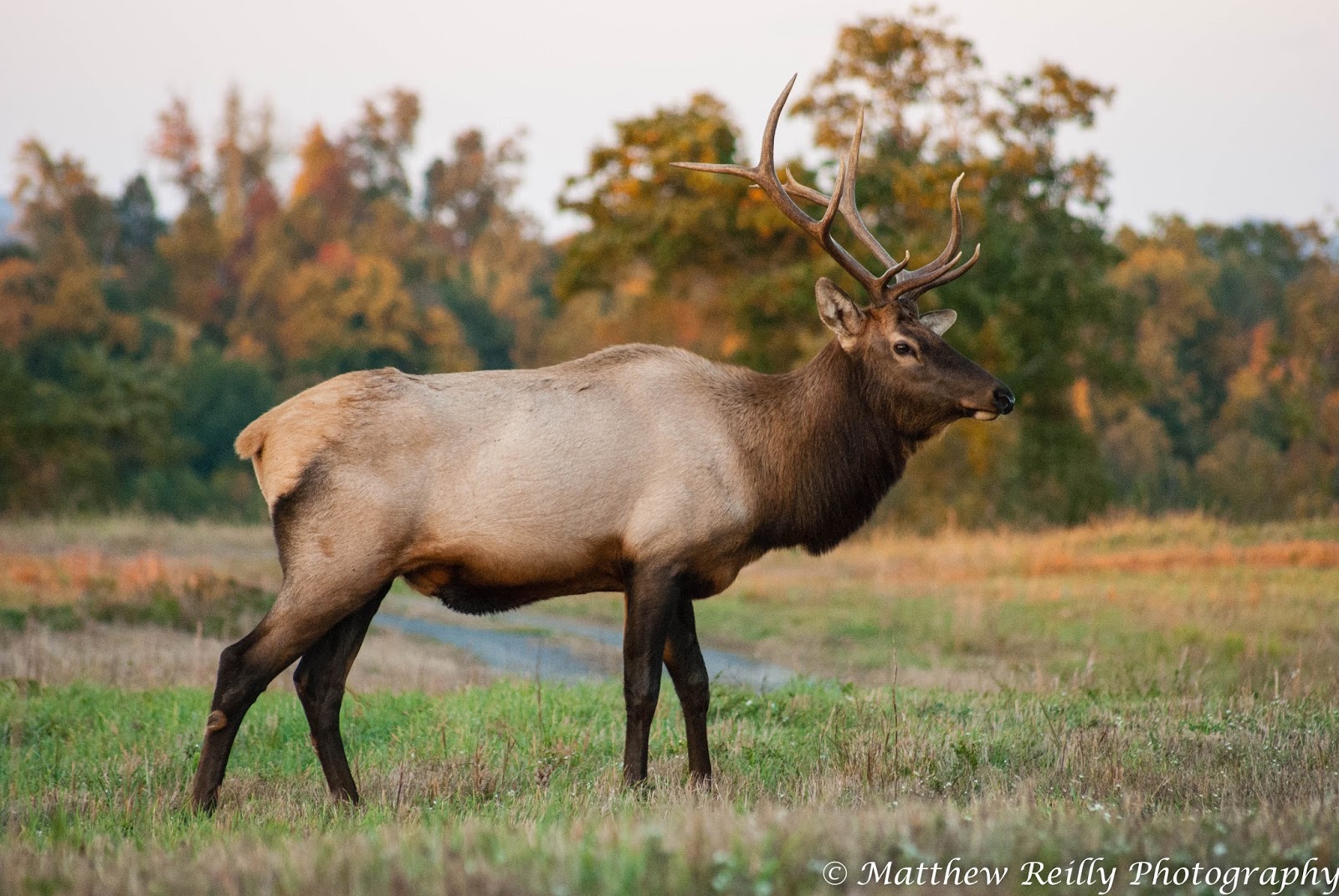
5x5 bull elk taking stock of his field in Buchanan County, Virginia. Photo by Matt Reilly.
    After glassing from an opposing mountain vantage point and driving hurriedly over gravel and tall grass, John Taylor of Vansant, Virginia, a volunteer with the Southwest Virginia Coalfields Chapter of the Rocky Mountain Elk Foundation (RMEF), brought his lifted, dark emerald Excursion to a grumbling halt, eyes fixed on a few dozen hide-colored bobs populating a rolling fescue field.

    I’d been there before, and recognized the terrain bathed in clear moonlight and the palpable feeling of natural history in the making. Only this time, the mood was much wilder. My previous visit was two and a half years ago. At 2:00 in the morning, I stood in the company of Virginia Department of Game and Inland Fisheries (VDGIF) staff and RMEF volunteers—their eyes glued to an enclosure, on which headlights born of Kentucky would soon appear hauling a livestock trailer containing 45 of the hide-colored bobs.

    That young April morning of 2014 marked the last installment of a three-year plan to restore elk to the state of Virginia. A subspecies of elk, the eastern elk, is native to western Virginia, but was extirpated by early human inhabitants—the last individual killed in Clarke County in 1855. Since then, in recent history, there have been a few failed attempts at reestablishing a viable herd in the Old Dominion, but each met a calculable end. However, the 72 Rocky Mountain strain individuals trucked in from Kentucky to the reclaimed strip mine site in Buchanan County, and protected within the designated “restoration zone” of Buchanan, Dickinson, and Wise Counties, has shown tremendous success, and now boasts a herd of 160-165 individuals.

    Camera cradled, I climbed from the Expedition, followed by Taylor, and stalked quietly behind a screen of brush to subtract twenty yards from the distance separating us from the elk. Light was insufficient for my camera, but I already had pictures. I found more light through the glass of my binoculars.

    The hide-colored bobs grew hide-colored ribs and shoulders; cinnamon bellies and legs; and shaggy, chocolate manes. Some grew antlers branching once, twice, three and four times from each main beam. All grew wild eyes.

    Then an old, stately bull emerged from a treeline just over a fescue knob.

    “I’ve never seen him before,” Taylor breathed. “He’s not one of ours.”

    His eyes fell on me, then on the dozens of cows grazing in the field. The rut is winding down, but the need to breed is still in their psyche, and he likewise began rounding up a few stray females. He was shaggy, totally chocolate—almost black—with a 6x6 rack, beams and tines dark, save for ivory tips.

    A few satellite bulls milled about the field, paying more attention to the dominant bull than to the females in the herd. One younger bull—a lanky 4x4—was left behind, once the chocolate bull had rounded up his harem. The dominant bull turned to face him, and slowly began walking towards the bull, occasionally throwing his rack back and extending his neck, as if to bugle, but without sound.

    The gap between bulls was closed to a few feet. The 4x4 looked puzzled, and the chocolate bull passed him by without incident. As if told to keep up, the 4x4 then trotted towards the treeline where the group of cows were exiting the field. The chocolate bull followed suit, and in the fading light, made a few attempts to mount one of the trailing cows.

    The woods just inside the opposing treeline were torn apart as a massive 7x7 bull charged into the field, pounding the ground with hooves driven by 700 pounds of muscle, gleaming rack thrown back in aggressive trot. He charged into the center of his harem, reclaiming ownership, and booting the chocolate bull from the field and into sexual and social exile in the hollow below.


    Turning to take a visual survey of his territory, his cows swirled around him as he tossed his headgear back and, with shaggy mane outstretched, hurtled a piercing, cocked-jawed, guttural screech into the night that rattled my heart on its arteries like a yellowing leaf blasted by a November wind. There was crashing and hoof stamping where there hadn’t been for almost two centuries, and a home-again drama of the autumn woods disappeared as quickly as it unfolded into the moonlight-cloaked thicket.

*Originally published in the Rural Virignian

Wednesday, November 25, 2015

LEAN FORWARD, PADDLE HARD

Finally relaxed, nose mechanically plugged and eyes squeezed closed, I pushed my hands past my ears and over my head, tracing the rim of the cockpit for a nylon loop attached to my skirt. As quickly as I found it, I formed a fist and ripped it over my head, twisting, pushing free, and bursting from cold river water into a seasonably warm early fall afternoon.
Public Domain photo.
    Knee deep in slack water, the South Fork of the Holston River dripped from my traumatized face. I had just completed my second ever “wet-exit” from a whitewater kayak, as a prerequisite for my first run down one of southwest Virginia’s domineering rivers. I was green, to say the least.

    Whitewater kayaking, on all counts—from the construction and maneuverability of the craft to the safety precautions and nature of the game—, is a different sport entirely from flatwater kayaking or floating a moderate river in a sit-on or sit-in boat. It’s a win-lose battle with hydrologic currents in which every stroke, every tilt, every pressure point, is a decisive action.

    Luckily, there’s one hard-and-fast rule that I was repeatedly offered—lean forward, paddle hard, even if you’re backwards.

    Jim Harrison, Director of the Emory & Henry Outdoor Program, whose boat I followed like a distressed duckling down the first rapid, echoed this advice from ahead.

    The first piece of whitewater I was up against was a choppy rapid I would be tempted to dub a “narrow” as a fisherman. A multitude of large rocks studded the riverbottom as the river’s width halved, resulting in a frothy water slide 200 feet in duration.

    From an upstream position, I did my best to center my weight in the boat, lean forward, and dip short but powerful strokes at the bow, managing to keep a straight course, even when falling into the holes behind larger boulders. The bow would dip, get drawn down by tumbling water, and pulled forward, until the hull met the system and bucked the whole craft upright, and over the bulge, each rapid paddle stroke an anchor point.

    Covered in spray and pumped with adrenaline, I battled through to the tailout upright and oriented, until I hit the tailout, that is. Relaxing, I must have put more weight on the left side of the seat, because the bow swerved to the left while I still had a good amount of speed. Luckily, I remembered to paddle, and saved myself from a coldwater swim.

    A few hundred yards of flat water provided me opportunity to practice. Consistently tracking a straight path remained a difficulty. I couldn’t solve the left-hand spin.

    Regardless, the next obstacle was up, this time, complete with a belligerent name—“The Fist.”

    The others in our party, seven students from the College, took turns shooting the famed rapid, one at a time, each aiming to trace the same “line” through the system.

    When at last it was my turn, I was still skeptical of my sub-novice ability’s suitability for the task at hand, but, determined to give it my all, went forth anyway.

    “The Fist” is a rather tight rapid, the safe and preferred currents of which run tight to the right bank, under several overhanging tree limbs, and finally through a choppy froth near the tail, which quickly meets an outward jut in the bank.

    Leaning forward and paddling hard, I managed to save myself from flipping through to the end. Still, I had built up enough speed to make the approaching jut dangerous. Human instincts being what they are, my eyes were locked on the danger zone (a recommended practice when rowing a driftboat or raft), influencing my balance and keeping me straight on towards collision. Thankfully, I managed to shift my weight and avoid conflict with the trees.

    Light was fading fast from the river valley as we approached takeout. Only one obstacle was left to conquer. “Triple Drop” is a relatively straightforward rapid, save for the three sudden drops of a few feet, and the eddies that accent the current seams. Maintain a straight course, and avoid the back eddies, and you’re golden.

    I was second in line this time, behind a friend of mine. Our line ran at first tight to the left bank, under overhanging limbs, then towards the middle of the river where the drops started. Drop one spat me out disoriented—sideways. A few paddle strokes corrected the issue, just in time to take on the second.


    However, at the last second, an eddy grabbed my bow and swung me backwards. Still straight, although in reverse, I was pushed over the second drop. The third drop came, and the story was the same—backwards, but leaning forward, paddling hard. I landed intact, redirected my course, and found takeout.

*Originally published in the Rural Virginian

Tuesday, November 17, 2015

A MORNING WITH THE VILLAGERS

Mountains are the world’s best hiding places. They can shield you from what’s immediate and threatening and place you closest to what’s most important in a single breath. This, I am certain, was God’s intention; to move or alter one should be a sacrilege. The communities and cultures that emerge at the end of the roads that navigate the folds and ridgelines, and cross the creeks that animate them, are, by design, strongholds for old-world values and charm. Thus my soul is pulled down secondary roads that lead up and away.
Photo by Matt Reilly.
    For a few hundred miles, as they dive into the southwest corner of Virginia, the Appalachian Mountains find girth. The highlands to the west begin to expand from the narrow crest that mounts in the central part of the state, and continue to do so as they roll into western North Carolina and eastern Tennessee—the Great Smokey Mountains. Ridges and fertile valleys take turns striping the land to the east, giving rise to a number of small mountain towns that once dotted a railroad that wandered the valleys and hollows.

    Taylor’s Valley is one such destination. Nestled in the palm of the southwest Virginia highlands, the village is as far removed as you can get in just a 15-minute drive from Damascus—affectionately dubbed “Trail Town USA.” Fork Mountain, which separates the two populations geographically, pushes the traveler south into Tennessee along a mountain highway before a ramshackle, faded, wooden sign directs him northward along a pot-holed road back into the state from whence he came.

    While I refrain at all costs from writing about secrets, Taylor’s Valley is none such. In fact, visitors—hikers—en route from Springer Mountain, Katahdin-bound on the Appalachian Trail, pass through shortly after making their collective favorite stop in Damascus. Perhaps Virginia’s most popular bike trail, the Virginia Creeper Trail, drives dozens of bikers through town daily. A single-lane bridge spanning Whitetop Laurel Creek—arguably one of the highest quality trout streams in the Southeast—is the town’s welcome mat.

    Gardens are plentiful; gas stations, nonexistent. Churches outnumber restaurants, which are few; and on a pleasant fall morning it would not be a surprise to find the majority of residences vacated for the comfort of nature. The Game Department’s regular stocking of the creek throughout fall and spring makes the retired man sporting hip-waders, creel, and limber spinning rod a common character—canine companions are optional, but largely endorsed.
Photo by Matt Reilly.
    It’s a homey place. That’s the impression I got when I opened my car door in a small gravel shoulder by the creek to find my very own dog waiting for me, like a housewarming present for my sojourn. Perky ears and friendly eyes stared me down, a wet nose implored my hands for attention, as I shouldered waders and strung my fly rod, intent on sampling some of the Valley’s aquatic villagers, but not without satisfying its four-legged one.
Photo by Matt Reilly.
    Golden leaves barreled down the creek pecking at my fly line, catching my fly on occasion. Patience and persistence payed out, though, in the form of four chunky brown trout, flamboyantly adorned with spawning garb.
Photo by Matt Reilly.
    I released the last fish and looked up to notice an elderly man fishing a good way above me. I stepped out of the river to explore upstream and give the man some space to enjoy the morning, but happened upon him leaning by his aged red pickup, retired from fishing.

    “Seems every time I looked you were doubled up with one of them!” he exclaimed.

    “The jury’s still out on the luck part of it,” I returned politely.

    “Any browns,” he inquired?

    “All browns,” I replied,

    “Huh,” he returned, hoisting a stringer of four rainbow trout. “They looked pretty good sized. Last year the state did a questionnaire asking people if they’d have lots of small and average fish or fewer bigger fish, and I think they settled on bigger. Works out good for me. I come down here when I can, but I don’t fish any of those other creeks. This one is the prettiest.”

    “There’s something to be said for that,” I said. “They say ‘trout don’t live in ugly places.’ Those are some nice fish.”

    “Tell me, are you a Christian?” he asked.

    “Yes, sir,” I said.

    “I thought I could tell it on your person,” he replied, smiling. “Most folks here are. Some of ‘em opened up their home as a café for the bikers. Their chocolate cake won some award in one of them southern magazines.”


    Talk of family and fishing petered out after a snack and a wave. I moved upstream to explore, caught a dozen more trout, exchanged waves with the bikers and hikers, and thought a familiar thought: These hills are home. And everything in them.

*Originally published in the Rural Virginian

Wednesday, February 25, 2015

WINTER ROSE

A new chapter of my life’s story began on the year’s second weekend as I rolled south down I-81, towards Emory, Virginia—my new hometown for the four years to come.

Photo by Matt Reilly.
    “Town” is a generous classification of Emory.  Emory & Henry College, a few quiet residential streets, and a post office comprise its bulk, a fact that consistently elicits a grumble from a proportion of students—“There is nothing to do here.”

    On the contrary, I’d be lying if I claimed that E&H’s location carried no weight in my college choice.  Southwest Virginia’s “Mountain Empire” is a mecca for outdoor recreation.  The school’s stellar reputation only justified my decision, assuring me of the wonderful experience it would offer. 

    I spent my previous semester acquainting myself with the East Coast, not in the common sense detailed in rest stop brochures, but by experiencing natural communities and interpreting them with pen, camera, tent, and rod.  The move to Emory was an extension of that pursuit, with added promise of formal education.

    It was a challenging transition—pivoting from a lifestyle that allowed me to be outdoors all day and every day to one that required schoolwork.

    However I realized shortly when my free time would be and where I would use it.  A tip from Bruce Wankel, owner of the Virginia Creeper Fly Shop, sent me into the mountains with confidence.  The concept of starting anew accumulating knowledge of local waters excited me, and I steadily began picking apart a small, special-regulations, spring-fed headwater stream.

    My first trip began at mid-morning on a cold January weekday.  The sun beamed through the trees and onto the water coursing through the hollow, inspiring marginal insect activity.  My first fish came on a weighted nymph—a red-banded, rosy-cheeked, leopard-spotted wild rainbow trout of about 9 inches.

    I began subsequent trips above the pool that concluded my last; keeping my eyes open; noticing the presence of insects; adjusting weight, tippet, and flies as needed--all to solve the puzzle. 

    The first three trips saw increasing numbers of fish—15 to 25 to 35.  Local intel informed me that a 14-inch rainbow was a trophy specimen.  This was encouraging, having netted several such fish on my outings. 

    My fourth trip began early on a weekday in early February.  The temperature dipped into the teens overnight and remained there, the sun shielded by clouds.  15 MPH wind gusts drove the chill deeper.
Under Armour, wool socks, flannel, outer layer, gloves, beanie—with each layer I pushed temptation to stay home back, and the icy river regained its allure.

    The river snaked through thick bottomland as I followed it from the road, my mind’s eye recalling the last pool from the week before.  A sharp bend caught my eye.  I pulled over.

    As my boots crunched over frozen leaves, I estimated the amount of river left to fish.  Fishing all day would land me at the uppermost boundary of the special regulation water, and I would have completed my exploration of the upper river.

    The day began slow, maybe a function of the overnight temperatures.  I summoned all of my patience and diligence, ensuring with painstaking adjustment that my offering retained contact with the riverbottom at all times.  At last, the first fish of the day flashed at the end of my leader.

    The day offered many small fish.  All but one out of 35 taped under 12-inches upon the hour that declining temperatures and loss of light hinted that my time was short.

    Around the next bend, a metal sign hung from rusted cable spanning the river—the end of public water—my destination.

    The sign commanded a bend in the river—a narrow, deep channel sweeping over large chunks of rock.  I took my time in plying the bottom, adding split shot and achieving effective drifts.  A last pool deserves such treatment; and this one, a particularly elevated reverence, as the last run of my month-long exploit.

    The soft glow of the sun behind winter’s gray mask was sliding behind the hills.  Frost chewed at my fingertips and nose, tempting me to secure my fly and begin the hike back.

    One more drift.

    An overhand lob of an awkward double-nymph rig weighted with several split shot landed high in the shallow head of the run and tumbled slowly along the bottom to the depth of the bend.  Rod horizontal, line tight, I bounced the flies past a submerged rock.  The line hesitated.  I swung for the sky.


    Warmth reclaimed my extremities.  Sweat sprouted from my forehead.  A rolling silver flash threatened to tear the long rod from my hands.  Moments later, an arm-length fish painted as a rose bush took to the dim sky, turning the page on the first chapter in the frozen mountains of southwest Virginia.

*Originally published in the Rural Virginia