Tuesday, December 20, 2016

FIRST BLOOD

I don’t like killing things.

Photo by Matt Reilly
    That may come as an unexpected confession from one who loves the sport of hunting, and has a somewhat precipitous body count in the area of squirrels and deer. I’ve got a lot of blood on my hands—not in the least figuratively. No more, though, than any regular consumer of meat. I don’t like killing things, but I don’t think twice about it.

    Every year, there’s a first blood. The hunting seasons take a siesta for the summer, and I join them, wet-wading the creeks and farm ponds of Central Virginia, casting flies and spinners for the usual warmwater varieties. The return of autumn and crisp days brings the annual opening days, and the ensuing fight between life and death that rages in the woods between man and beast, in the dying embers of hardwood trees. Some years it’s a squirrel. Some a bird flushed from cover. Some, a deer that gives its life and welcomes me back.

    This year, it was a deer. A six-point buck, built like a race horse. I took its life in the young of a harsh October morning. Squirrels danced haphazardly in the limber crowns of sweet gums, and resident geese onk-or-ed on high, on their way to splash-down in the nearby pond. He was relaxed, munching on clover in the gray shadow of a pine thicket, as the sky illuminated a bluebird sky, before beams of sunlight could get a direct shot at the ground. He was preparing for the day with a trip to the clover patch.

    My shot was good. He rolled over in his tracks, before the foul effect of adrenalin could marinate his muscles with the taste of death. I have no precise body count, but the cosmic tally he marked was one of several. My nerves are considerably calmer prior to the shot now than they were years ago with my first. I don’t like killing, but I understand it, and I embrace it. And I’ve learned to do it with dignified purpose.

    A sliver of guilt flashed through my mind as I approached the buck and took a knee. Of course, his spirit had long since departed, but it’s a motion I require of myself, to pay respects to the dearly departed.

    Dearly? Perhaps if I enjoyed the act of killing, I would not be so attached to the animal, so profoundly touched by its passing. But Dearly? The offensive voices of a defensive, out-of-touch society scream at me: What reasons have you for killing this creature? Is your life worth more than its?

    It is not. I know that there is no hierarchy in the value of lives. There is only predator and prey. In that moment of sustenance acquisition, I thought of the coyotes and the rabbits that probably jumped at the echo of my rifle shot through the pine thicket. One’s existence is dictated by the other in a series of checks—the coyotes’ by the health of the rabbit population; the rabbits’ by the vitality of the coyote population. I thought of the rearing of a pup coyote, and the rite of passage that was its first kill—the rite of passage that was my first kill—and the realization that in order for one to live, another must die.

    This realization I revisit annually, in some holy October arena lit by the dim light of a waning or waxing day. And though I do not enjoy killing, I have come to cherish the emotional consequences. To take a life and stare into the inanimate eyes of a fellow being is to declare one’s own mortality, to claim a culturally forgotten equivalence within the ecosystem, a clear position within the food web.


    These consequences I hold as advantages over the faction of humanity far-removed from the drama of nature—to experience in their rawest form remorse for loss of a life, respect for a departed champion of their environment, integrity as a steward of the Earth, thankfulness for a bounty endowed unto me, human for my inclusion in all of it. And I promise my continued participation to the animal and to the Earth in repayment for the perspective.□

*Originally published in The Rural Virginian

Friday, December 16, 2016

BEAVERS, LOONS, AND OTHER POOR GAME FISH

I caught a beaver once. Rather, I almost did.

Photo by Matt Reilly

    One summer evening I was bass fishing a small farm pond when I eyed hopefully a beaver hut in a few feet of water. I delivered a plastic worm to the doorstep, let it sink, and gave it a small lift off the lake bottom with my rod tip. Animated resistance brushed the hook and jumped through the line into my hand, and I set the hook with gusto. The hook didn’t drive home, but an ovular, chocolate mat of hair breached at the end of my line and slammed the door with its paddle tail—communicating its lack of enthusiasm for my housewarming gift and sending water a story into the air.

    A similar thing occurred another summer while dry fly fishing a promising run on the Moosehead Region’s Roach River. My gaze hadn’t yet found the hut on the far bank when a coffee-colored submarine (that would have quadrupled the state’s brook trout record) rose out of the center of the run towards my stimulator as I stood by dumfounded and struggling to react. It of course bypassed my fly and headed for cover, but not before I had time to reflect upon its bizarre choice of behavior. Had I been nymphing, I surely would have had him.

    Both occurrences are memorable and, I often think, might have been more so had I succeeded in placing a hook in beaver flesh. But I’ve seen—and heard at midnight in a swamp—what kind of power those oversized rodents can command with their tail, in a pinch—not to mention their infamous caramel incisors—and I count my lucky stars it didn’t end up that way.

    Surf casters know a kindred issue, especially if they’re doing it right. Birds and predator fish both chase bait, rolling in a dizzying tornado of adrenaline that the surf caster is charged with threading a weighted object dressed with treble hooks through from a distance. Thus the star-crossed gull occasionally finds itself smacked into a downward spiral by the spoon-shaped hand of God and subsequently skittered over the surface and sharks onto the beach to be toyed with by a herd of bumbling humans.

    I’ve known a handful of individuals to have completed the feat and released the seagull to return to its position as bowling pin of the surf—an honorable accomplishment given the general temperament of a hooked gull. And though it’s a conversation starter in some briny circles, it’s hardly a pleasant undertaking in the moment.

    Likewise, loons patrolling the more heavily fished brook trout ponds of Maine have decided their role in catch and release. As accomplished swimmers, they’ll dive from a safe spectator’s distance to nab the struggling brook trout produced by a canoe and a fisherman’s bent rod.

    This understandably incites some frenzy in the fisherman, and though I’ve never personally been faced with the task of removing a fly from the gullet of a loon, I can’t imagine them to be ideal canoe company.

    The snapping turtle would argue its superior displeasantry. It’s my theory that the Old Man was in the beginning stages of snapping turtle sculpting when serpentina opened its beak with an aggressive hiss and was flipped down into the farm ponds of the world pissed off.

    I have a grandfather who caught one measuring over two feet long with rod and reel, once, from a john boat on the lake in Tidewater Virginia where he built his home. It was “landed,” so to speak, and the shell promptly spray painted orange so as to be seen from a distance, and avoided at all costs.

    I remember it vividly, as I do the evening I spent casting dry flies to rising rainbows and browns on a very low Pine Creek in north-central Pennsylvania. The sun was dropping below the horizon and I was praying for a trout to have a moment of poor judgement. As I reached out further, to another rising fish, my backcast tipped a shoot of broomsedge on the bank behind me. Only when I turned to take stock of the situation, the perked ear of a black bear was frighteningly close to that waving grass shoot.


    I counted my lucky stars as the bear cursed my foul casting ability, and pondered the consequences of landing a #14 brown caddis a job as an earring. Today I tell that story with pride, though it could have ended in tragedy. And I go on my normal way, casting to trout and smallmouth, avoiding the oddities at all costs.□

*Originally published in the Rural Virginian

Thursday, December 15, 2016

DROUGHT

It's been a while since I put fly in water. A while by my standards.


    The southwestern corner of Virginia has been experiencing a drought that's run on since early September. And once the smallmouth fishing slowed in October and trout fishing would have theoretically taken over, streamflows bottomed out. So, for lack of ideal opportunity, I yielded to my duties to academics, to my freshmen residents, and to writing, disheartened by the environmental condition, and chivalrous towards the fish in their stressed state.

    Dare I say, it's been the better part of a month since I've strung up my four weight and felt the chill of mountain water and the slime of a wild trout on my hands. A sharp contrast to my summer's industry, fishing darn near every day, pausing to hear what carries me in the mountains, and fulfilling passion as often. Despite the weight of final exams mashing pedal to metal and the oncoming roller coaster of the holiday season, time has slowed to a crawl, like the flat, meandering trudge of the South Fork of the Holston creeping through defoliating hollows. I’ve grown less tolerant of daily disturbances. Life, through my eyes, is less rich without the regular return to nature.

    It's been nearly a month and in that time there have been several deadlines. Several deadlines that were not met clacking excitedly away at the computer, eyes still sparkling, translating the majesty of brook trout and a mountain stream explored over the weekend, or the sense of accomplishment at duping a sex-crazed brown from the South Fork into tearing into a streamer before class. In these periods of real-time inspirational drought, I dive into reflection, focus on a memorable or defining moment, and celebrate it. For what means bounty without shortage?

    It's been...24 days since I last set foot in my home water, but today I'm breaking the streak. Such a hiatus constitutes an emergency, and I have to tend to it, regardless of reward. I've long been proud of my ability to adjust to different angling situations, and have regarded time on the water as a powerful exercise in realignment and realized identity. After all, what means a singing stream without the whisper of drought?

    The water is cold, despite its level, as I slosh my way upstream through the familiar vein that slices through thousands of acres of national forest land. The sun pulls the barren forms of hardwoods over its face. My mind expands into the hills and then sounds inward like the rapidly branching plot of a soul-striking novel. I am home again.

    The usual riffles and runs are choked, empty and exposed, but the deeper holes retain promise. A small black stonefly nymph dropped quietly at the head of a large aqueous bowl rouses the spirit of a wild rainbow typical of this stream.

    Mine is roused, too. It's been a while.

    In that time, we, the American people, elected a new head of state. There were struggles before him—against the movement for federal land transfer, for action on climate change, for a healthy transition to a more sustainable future—but they were catalyzed by a statesman who believed in such things. The newly elected has made clear his intentions of slamming shut that policy window, with interest in coal and oil over the health of the Earth, favoring impolitic lust for capital over survival. Progress is always hard. Sometimes it’s harder. But what is a movement without opposition? Passion without test?

    It is admittedly difficult to maintain hope in light of these events, standing in the stagnant nature of autumn-thus-far in the Southeast. In a puddle of a river once coursing. In 70 degrees in November. In a drought egged on by the hottest summer on record. Watching the fall brown trout season evaporate, and the story potential of my favorite season squandered. Such stressors even the river can’t save me from, and so my stimulus-starved mind rages, hungry for action. I could give up. But I can’t.


    It’ll be a while—that much I’m sure of. Winter, probably, before the return of seasonal rainfall, and the restoration of a healthy fishing pattern and flow of stories to write. Four years, at least, before the majority of representative government stands faithfully on the side of the Earth and the rivers and streams that support the sporting lifestyle we live.

    The water will rise, once again, and the fishing, the writing, the fighting will be easier. But integrity keeps on when the going gets tough. So in the meantime, I’ll be at the river, persisting, waiting. For what means victory without struggle? □

*Originally published in the Rural Virginian

Friday, November 4, 2016

HUNTING FOR HERITAGE

There is urgency in the air, while the world slumbers. The sun is rapidly approaching the horizon line. My eyes flash open, tipped off by an alarm clock and without a thought to flicker. Predetermined getup is taken on. A hastily prepared bite is consumed laboriously in dim kitchen lighting. Sharp cold and the aroma of coffee sting my nose as I push through the door outside. The hot liquid pours down my throat and warms my body.

    The truck is preloaded and grumbles to a reluctant start. Cab lights make the world darker, but can’t fight sunrise. It’s on its way. I’ll beat it to the clover field. Dutifully, I throw the vehicle into gear and head out into the world yet-to-stir.

    White pine crowns, silhouetted by a growing gray haze in the sky, guide my approach. Feet crunch on the stubble of a recently hayed field. I’m an intruder in the world, under cover of darkness, hoping to make my stand before the first whitetail makes the short amble from bedding thicket to field edge.

    Stakes are highest as I creep carefully to the back corner of the clover field, and enter the woods via a whole in the brambles I’ve previously cleared. I find my blind how I left it, though its weathered a few days and become a part of the landscape—no longer an item of distrust for the local wildlife community. I unfold a small stool, settle my bow in my lap, and begin my vigil over the awakening world.

    Darkness turns to gray and gray to white. The temperature drops noticeably a few degrees with the peeking of the sun over the horizon, as the day laborer turns a defiant shoulder to their alarm clock. It’s deafening, the calm.

    In this moment, this moment of raw possibility and wonder, I come down from my cloud. As these days clog my spiritual pursuits with schoolwork, conducted hours away from the woods I know, scouting is an activity necessarily, though unwillingly, scrapped from my process. Will I get lucky? My hunting effort is not premeditated. There are no likelihoods.

    But more importantly, there is tradition.

    Whether on opening day or some equally as nominal first bout with deer season, there is the remembering of hunts passed, and the nostalgic rediscovery of the sights, smells, and emotions that came with them. There is the physical admission of inclusion within the food web, and an intention to remain.

    There is anticipation of hunts to come, of skills to learn and classical ambition to please. There is a legacy of adventure and grit, a lifestyle perceived as nothing more than necessary habit.

    There is a home in the mountains, and the farm that goes with it. There are autumn days when working outside is comfortable and the willing slavery to a livelihood of passion is reflected upon with a rose-colored lens. There is thankfulness.

    In the wide-eyed world of chirping woods and sugar gums crashing under the weight of a spunky bushytail there is the profundity of morning and a renewed chance at living. There is the ritual of coffee and prayer, and two dogs in the front yard, going through the same motions, but with unrestrained lopes and wind-whipping ears.

    There is a squirrel hunt like I used to, and the preparation of the harvest and the resultant tie to the land. There are two kids to help, filled with questions and burgeoning passion for the world.

    There are first hunts that remind me of my own. And in that there is heritage, and the scrappy morning hunts of my youth to refuel the tradition.


    And in it all, there is comfort.□

*Originally published in The Rural Virginian

Wednesday, October 26, 2016

ELK RETURN TO AUTUMN IN VIRGINIA

A fire burned on jagged mountain crests above the landscape of a reclaimed strip mine, from within the crimson and apricot leaves of expiring hardwoods. The setting sun painted a halo of orange on the pointed peaks, topped by the glowing pale blue sky of an early-to-rise hunter’s moon, casting silhouettes of mountains and coal fields spanning west into Kentucky, north into West Virginia, and south and east into the more populous regions of southwest Virginia’s Mountain Empire.

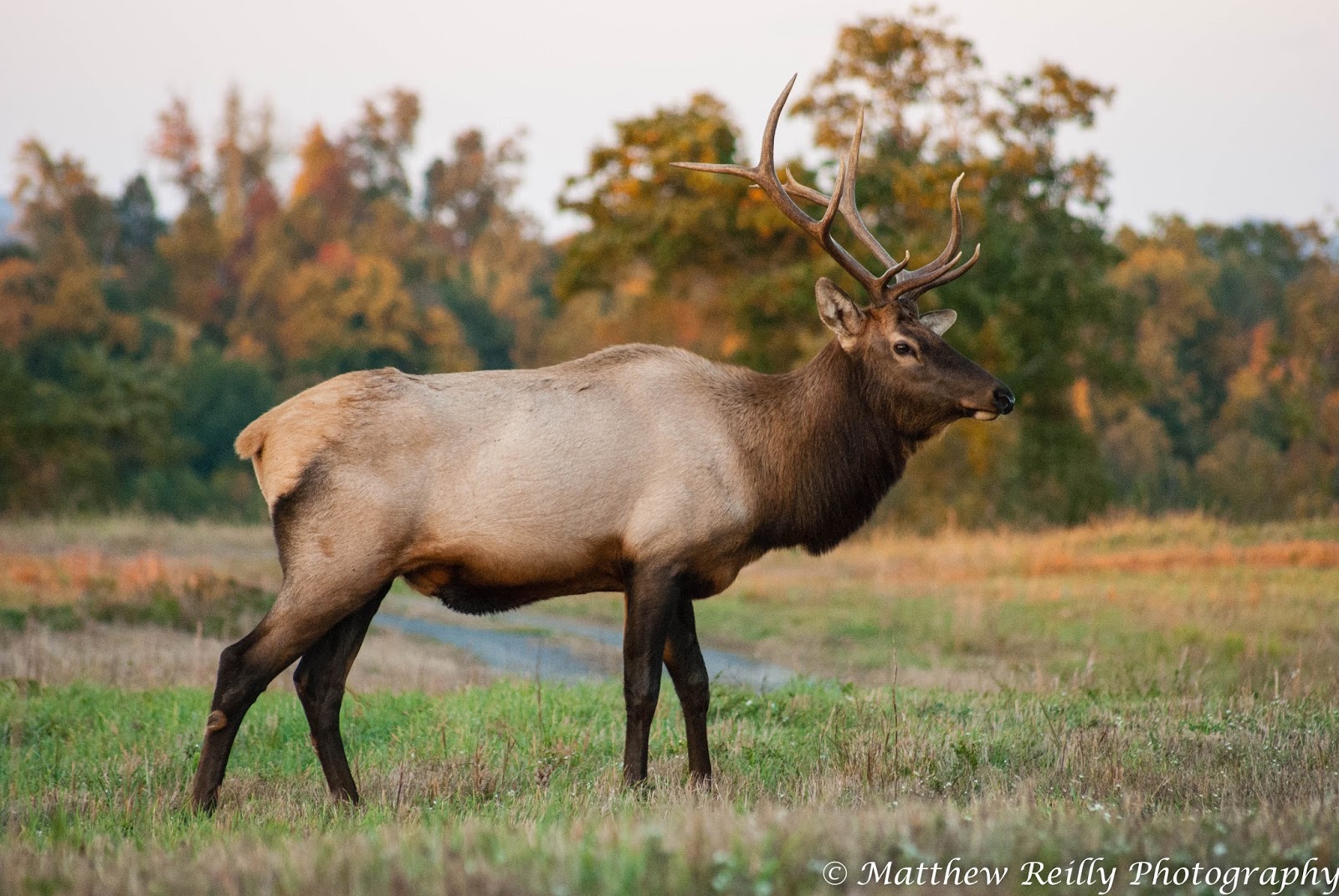
5x5 bull elk taking stock of his field in Buchanan County, Virginia. Photo by Matt Reilly.
    After glassing from an opposing mountain vantage point and driving hurriedly over gravel and tall grass, John Taylor of Vansant, Virginia, a volunteer with the Southwest Virginia Coalfields Chapter of the Rocky Mountain Elk Foundation (RMEF), brought his lifted, dark emerald Excursion to a grumbling halt, eyes fixed on a few dozen hide-colored bobs populating a rolling fescue field.

    I’d been there before, and recognized the terrain bathed in clear moonlight and the palpable feeling of natural history in the making. Only this time, the mood was much wilder. My previous visit was two and a half years ago. At 2:00 in the morning, I stood in the company of Virginia Department of Game and Inland Fisheries (VDGIF) staff and RMEF volunteers—their eyes glued to an enclosure, on which headlights born of Kentucky would soon appear hauling a livestock trailer containing 45 of the hide-colored bobs.

    That young April morning of 2014 marked the last installment of a three-year plan to restore elk to the state of Virginia. A subspecies of elk, the eastern elk, is native to western Virginia, but was extirpated by early human inhabitants—the last individual killed in Clarke County in 1855. Since then, in recent history, there have been a few failed attempts at reestablishing a viable herd in the Old Dominion, but each met a calculable end. However, the 72 Rocky Mountain strain individuals trucked in from Kentucky to the reclaimed strip mine site in Buchanan County, and protected within the designated “restoration zone” of Buchanan, Dickinson, and Wise Counties, has shown tremendous success, and now boasts a herd of 160-165 individuals.

    Camera cradled, I climbed from the Expedition, followed by Taylor, and stalked quietly behind a screen of brush to subtract twenty yards from the distance separating us from the elk. Light was insufficient for my camera, but I already had pictures. I found more light through the glass of my binoculars.

    The hide-colored bobs grew hide-colored ribs and shoulders; cinnamon bellies and legs; and shaggy, chocolate manes. Some grew antlers branching once, twice, three and four times from each main beam. All grew wild eyes.

    Then an old, stately bull emerged from a treeline just over a fescue knob.

    “I’ve never seen him before,” Taylor breathed. “He’s not one of ours.”

    His eyes fell on me, then on the dozens of cows grazing in the field. The rut is winding down, but the need to breed is still in their psyche, and he likewise began rounding up a few stray females. He was shaggy, totally chocolate—almost black—with a 6x6 rack, beams and tines dark, save for ivory tips.

    A few satellite bulls milled about the field, paying more attention to the dominant bull than to the females in the herd. One younger bull—a lanky 4x4—was left behind, once the chocolate bull had rounded up his harem. The dominant bull turned to face him, and slowly began walking towards the bull, occasionally throwing his rack back and extending his neck, as if to bugle, but without sound.

    The gap between bulls was closed to a few feet. The 4x4 looked puzzled, and the chocolate bull passed him by without incident. As if told to keep up, the 4x4 then trotted towards the treeline where the group of cows were exiting the field. The chocolate bull followed suit, and in the fading light, made a few attempts to mount one of the trailing cows.

    The woods just inside the opposing treeline were torn apart as a massive 7x7 bull charged into the field, pounding the ground with hooves driven by 700 pounds of muscle, gleaming rack thrown back in aggressive trot. He charged into the center of his harem, reclaiming ownership, and booting the chocolate bull from the field and into sexual and social exile in the hollow below.


    Turning to take a visual survey of his territory, his cows swirled around him as he tossed his headgear back and, with shaggy mane outstretched, hurtled a piercing, cocked-jawed, guttural screech into the night that rattled my heart on its arteries like a yellowing leaf blasted by a November wind. There was crashing and hoof stamping where there hadn’t been for almost two centuries, and a home-again drama of the autumn woods disappeared as quickly as it unfolded into the moonlight-cloaked thicket.□

*Originally published in the Rural Virignian

Wednesday, October 19, 2016

POOPING ON MOTHER NATURE'S FLOOR

I’ve worked at two different kinds of jobs in my brief 20 years—one that stimulates my mind and soul and satisfies the curious outdoorsman in me, and retail. And I haven’t worked retail much—just long enough to learn to despise it and that the biosphere is headed for the gutter. Let me explain.


    One particular day, during the few months I was employed by The Orvis Company in Charlottesville prior to college, a woman entered the store with her black lab. As she perused a shelf of gloves, I approached her and asked if I could do anything for her. She asked a series of piercing questions, to which I confidently provided answers I’d previously prepared by reading the garment’s packaging. She became incredulous and irate at my ineptitude after asking whether or not the gloves would conform to her hand over time and, having never worn that particular pair of women’s gloves for multiple seasons, I had to admit I didn’t know. She left the store silently, leaving behind a fresh pile of scat on the pebbly floor that I confidently identified as a black lab’s.

    After sifting through some strong adjectives, I got to thinking about the implications of her actions. Had she returned during my employment, I likely wouldn’t have greeted her so cheerfully. But what if she treated others the same way? I for one would think twice before allowing my dog to defecate on my barber’s floor, before insulting a potentially vengeful chef. But in an era when goods and services are acquired easily and impersonally, the motivation to respect the origins of such things is voluntary at best. The social ethic is weak.

    In a simpler time, when small businesses ruled and globalization hadn’t yet broken communal webs to bits, a respectful relationship with a farmer would ensure that you and your family had quality food when he had his. Loyalty to a mechanic or horseshoer would mean continued transportation and help in a fix.

    Small towns and the writing trade mimic this. Respect intel entrusted to you by a fly shop owner in humble Roscoe, New York, and you’ll get more. Betray that trust, and you’ll be the most hated individual in the Catskills. Consistently meet deadlines and turn in quality, well-researched writing, and editors will come to rely on your name. Fail to meet deadlines or make a habit of using copyrighted materials or faulty facts, and you’ll be blacklisted and your career will end before it began. These people talk.

    Rewind to a time even longer ago, when asphalt paved no inch of this continent, when people wore skins after eating what was inside. Hunting enabled eating, and was directly tied to forest health. The Shawnees of the Shenandoah Valley knew their fishing success depended on their relationship with the river, and that the vitality of their agricultural crop was a factor of soil health, which could be bolstered by applying fish for fertilizer.

    I hadn’t quite been born to experience those times, but I have a sneaking suspicion that any individual so blind to even think about clear-cutting a mountain, or dumping human waste into the Shenandoah River—or, God forbid, Naked Creek—would have been dutifully shunned. It’s most likely, however, that such transgressions were committed only by angry, rogue individuals. It’s downright dumb to think it inconsequential to torch your food supply.

    Despite it being lawfully looked down upon, a modern person of even base intelligence would comprehend the negative social impacts of burning down the local grocery store or poisoning the water supply. But the reality is that, though we’ve grown perceptually further apart from nature over the course of industrial human history, our dependence on the greater world ecosystem has remained static.

    Maybe it’s not everyday news for someone to burn the grocery store or poison the well, but acts like littering, spraying volumes of pesticides and fertilizers, and even the occasional (and totally preventable) oil spill achieve the same ends. Declining water quality due to contamination breeds declining soil quality, which requires farmers to pump more chemicals into their fields, lowering the nutritional value of our food, and killing the soil, requiring increasingly larger volumes of chemical correction. These acts often go unpunished, fly completely under the radar of the general public, or are hardly thought of as harmful. Or, the effects raise a temporary eyebrow, soon lowered with the idea that humans, in their fallacious, God-like reign over planet Earth, can engineer their way to a happy ending.


    Such thinking is irresponsible and short-sighted. Our social contract with Mother Nature is weak, and until we recognize this, and learn that we can’t poop on her floor without consequence, we will destroy ourselves as a species, and the earth on which we live.□

*Originally published in the Rural Virginian

Wednesday, September 14, 2016

SUCCESS

My dictionary features a perpetual list of definitions for the word “success.”

Photo by Matt Reilly.

    One is manifest by the personal discovery of large, wild fish in an otherwise humble setting.

    There’s a river in southwestern Virginia that fits the bill. I didn’t discover it. That honor belongs to Daniel Boone, or one of the uncelebrated pioneers of central Appalachia. I didn’t discover the tremendous smallmouth bass fishery that exists there, either, though I’ve discovered it personally this summer, and have likewise reaped the rewards.

    My success has come in its upper reaches, where the channel stretches no more than 30 yards across and winds quietly southwestward through the Valley and Ridge to rendezvous with its sister rivers in Tennessee. During the low, slow flows of late summer, an angler of average height can wade for an afternoon without wetting his thighs, should that be their wish. And so the game becomes identifying those holes and runs that would wet a thigh—and the shady banks of sufficient cover—and approaching them stealthily through ankle-deep water to present a fly.

    On one such afternoon, when I was indulging myself in just that challenge, I encountered a hole chest-deep under the solar protection of an overhanging riparian canopy. A riffle headed its body and supplied it with the rich supply of dissolved oxygen that doesn’t go unclaimed in late summer, and three current fingers carried little foam saucers like rafts upon a quaking sea down into the tail.

    From it I pulled three smallmouths of several pounds—each respectable and seeming novelties for the size of the river. Their spirits were strong, but hampered by the oppressive season, but I fought them quickly and released them to rebuild their spirit, as I have countless bass before them.

    I recall that afternoon while standing idly on that river’s bank, crouched in a sea of reeds.

    The Native Americans themselves, who inhabited and thrived in these river valleys for centuries, also constitute a definition of success in my dictionary.

    It was during my pre-teen years that I learned of the Natives’ practice of turning river reeds into arrow shafts, obsidian into arrowheads, and the trunks of sapling basswood and elm into longbows to be strung with woven hair or sinew from harvested game.

    I tried to replicate the process using raw materials from my backyard—shale in place of obsidian, beech limbs instead of river reed. The attempt failed, and I retired my efforts to the sound industry of crayfish trapping, and took on a new, practical appreciation for Native Americans and the skills they developed to succeed and thrive while leading a naturally sustainable existence.

    Beyond the river reed, the river ran lower, slower than when last I visited, exposing the brown scaled back of yet another of my definitions of success. In just six inches of water, the pulsing body of a common carp of about 14 pounds inched along a gravel bar just feet from dry land.  Every few inches of upstream progress would bring a gill flare and the flashing of a pale pectoral fin as it sucked in water to digest a tiny morsel found on the streambed.

    Omnivores, they eat anything. As large, spooky adults, they have few predators besides man. And as generalists hailing from the sluggish waters of the Old World, they can reside just about anywhere, and have come to do so the world over. Their attentive eyes distinguish more effectively than our own, and their highly efficient hearing mechanisms can detect the sound of monofilament vibrating in the wind.

    An aesthetically humble species, sure, but the carp is a master of its environment, and thus, a worth adversary.

    I hide in the reeds, watching the fish’s forward progress, playing a game with myself to see if I can predict its next movement. I analyze its body language. Is it feeding? Yes. Has it seen me? Perhaps.

    The fish’s track has taken it several yards upstream of an overhanging sycamore, and I decide to make my approach. Fly rod in hand, I dip a timid toe into the river, cringe at the gritting of gravel, and pause. The fish goes about its business unfazed.

    Not wishing to take any more steps than necessary and risk detection, I see my opportunity and I take it. A 50-foot cast unrolls and places a leader and tippet just a foot to the right of the fish. The fly plops down softly a few feet ahead of it.


    The carp’s head encounters my fly and jerks towards mid-river. With a firm thump of its tail, it disappears to hide among mid-river structure, and success evades me once again. I grit my teeth and my heart sinks. Next time, perhaps a bit more observation from the reeds and success will be mine.□

*Originally published in The Rural Virginian